

Are you looking for double inward opening aluminum windows that give you full-width ventilation without eating into the room? Do you want to find a China manufacturer that offers matched two-leaf inward casement or tilt-and-turn systems with reliable hardware and clean sightlines? Or are you hoping to source inward-opening windows that satisfy a European-style specification without the European price?
If the answer is yes, then China is your best choice. China boasts a deep cluster of aluminum window manufacturers who build inward-opening casement and tilt-and-turn systems for villas, apartments and hotels, with the profile tooling, hardware supply and glazing capacity to support both single-leaf and double-leaf configurations. Below, we present leading double inward opening aluminum window manufacturers in China to help you quickly find the right partner.
Quick Navigation
- Curma (Foshan Curma Building Materials Aluminum)
- OEFAS (Foshan Hildun Home Technology)
- Taiyang (Taiyang Window & Door)
- LEASKY (Fujian Guohua Construction)
- Foshan Angle Doors and Windows
- Zhengji Windows & Doors
- GONHO (Foshan Beilu Doors and Windows)
- LEAWOD (Golden Power Building Materials)
- GY Windoor (Guangya Curtain Wall & Window Door)
- ALUWF (Foshan NF Windows and Doors System)
1. Curma (Foshan Curma Building Materials Aluminum)
Website: https://www.curmawins.com/
Headquarters / Supply Model: Foshan Curma Building Materials Aluminum Co., Ltd., based in Songgang Town, Nanhai District, Foshan. The company reports three production factories, a total area of 200,000 m² and a monthly capacity of 40,000 m², with end-to-end manufacturing from profiles to finished windows.
Core Products / Technologies: A Tilt and Turn Double Inward Opening Window listed in the aluminum window range, alongside standard casement, sliding and fixed systems. Production covers aluminum profiles, doors and windows in-house, which means the profile, finish and assembly come from one chain rather than three vendors.
Why Consider Curma: The product name matches this article's category word for word — tilt-and-turn with double inward opening — so there is no ambiguity about whether the factory actually builds a two-leaf inward system. A 200,000 m² footprint with 40,000 m² of monthly output is large enough for container programs while still being a single-site supplier you can audit in one visit.
Best Suited For: Distributors and project buyers who need a named double inward opening tilt-and-turn window in volume, especially for residential developments and hotels.
Before Purchasing: The site shows conflicting staff and area figures across pages, so confirm the factory size and workforce in writing. Ask which hardware platform drives the tilt-and-turn mechanism, what sash weight it is rated for, and request air, water and wind test data for the double-leaf configuration rather than a single-leaf sample.
2. OEFAS (Foshan Hildun Home Technology)
Website: https://www.oefaswindow.com/
Headquarters / Supply Model: OEFAS is the brand of Foshan Hildun Home Technology Co., Ltd., based in Shishan Town, Nanhai District, Foshan, with a production base of 15,000 m², a workforce in the 101–200 range and ten production lines. Positioned as a manufacturer and service provider.
Core Products / Technologies: A Double Inward-opening Micro-ventilation Window presented in the company's project showcase, alongside casement, sliding and curtain wall systems. The micro-ventilation feature is aimed at rooms that need continuous fresh air without opening the sash fully.
Why Consider OEFAS: Micro-ventilation combined with double inward opening is a specific solution for bedrooms and hotel rooms where you want trickle ventilation and a full opening in the same unit. A 15,000 m² plant with ten lines is a manageable size for custom work, and ISO 9001 plus CE are stated, which covers the basic documentation most distributors need.
Best Suited For: Hotel, apartment and residential projects that want double inward opening windows with an integrated micro-ventilation function, in mid-sized volumes.
Before Purchasing: Confirm how the micro-ventilation path is filtered and whether it can be closed completely, since that detail affects acoustic and thermal performance. Ask for the hardware brand and sash weight rating, and verify that the CE documentation covers the specific system rather than the company in general.
3. Taiyang (Taiyang Window & Door)
Website: https://www.taiyangwindowdoor.com/
Headquarters / Supply Model: Taiyang Decoration Engineering Co., Ltd., based at No. 3 Fuhai Road, Tongzhouwan Demonstration Zone, Nantong, Jiangsu. Founded in 2003, with a 21,193 m² facility, roughly 20,000 m² of monthly capacity and 360+ employees, operating under ISO 9001, ISO 14001 and ISO 45001.
Core Products / Technologies: A Passive House Inward Opening Casement Window (BD93) sits alongside outward-opening thermal break windows (ES110), a screen-integrated window (BF115), panoramic and sliding doors, off-axis doors, a heavy-duty pivot door system, sunrooms and curtain wall. Thermal break windows are stated as tested to GB/T 7106.
Why Consider Taiyang: The BD93 series is an inward-opening casement designed around passive-house performance, which is a useful starting point if your inward windows have to meet an energy target rather than just a style requirement. The same factory covers outward-opening, sliding, pivot and curtain wall systems, so a facade with mixed opening types can be sourced and documented as one package under a single quality system.
Best Suited For: Project buyers and distributors specifying inward-opening casement windows for low-energy villas, apartments and mixed facades where windows, doors and curtain wall should come from one supplier.
Before Purchasing: Confirm whether the BD93 is available as a double-leaf configuration or only as a single sash, since the published catalog presents it as an inward-opening casement without stating leaf options. Ask for the Uw value, glazing build-up and any passive-house component certification, plus the GB/T 7106 report for the exact sash size.
4. LEASKY (Fujian Guohua Construction)
Website: https://www.cnghmc.com/
Headquarters / Supply Model: Fujian Guohua Construction Co., Ltd., trading as LEASKY, based in Nan'an City, Quanzhou, Fujian. The company reports a total production base of 100,000 m², including a 26,000 m² headquarters facility, and a workforce of around 500.
Core Products / Technologies: Double Inward-Opening Windows appear as a featured product category on the homepage, within a range that covers system doors and windows, curtain wall and green building materials. Certifications cited include ISO 9001, ISO 14001, ISO 45001, China's 3C mark and a national three-star green building materials rating.
Why Consider LEASKY: Double inward opening is a headline category rather than a variant, and the company carries a full three-system ISO stack plus the Chinese green building materials rating — relevant if your project has a sustainability scoring path. A 100,000 m² base with roughly 500 staff puts it in the range where both project supply and distributor programs are realistic.
Best Suited For: Project buyers who need double inward opening windows within a broader system-window package and who value environmental documentation alongside product data.
Before Purchasing: The site presents three different legal entity names across its pages, so confirm the contracting entity, the invoicing party and the factory address before issuing a purchase order. Ask for the hardware platform and test reports for the double inward opening system specifically.
5. Foshan Angle Doors and Windows
Website: https://www.anglewindow.com/
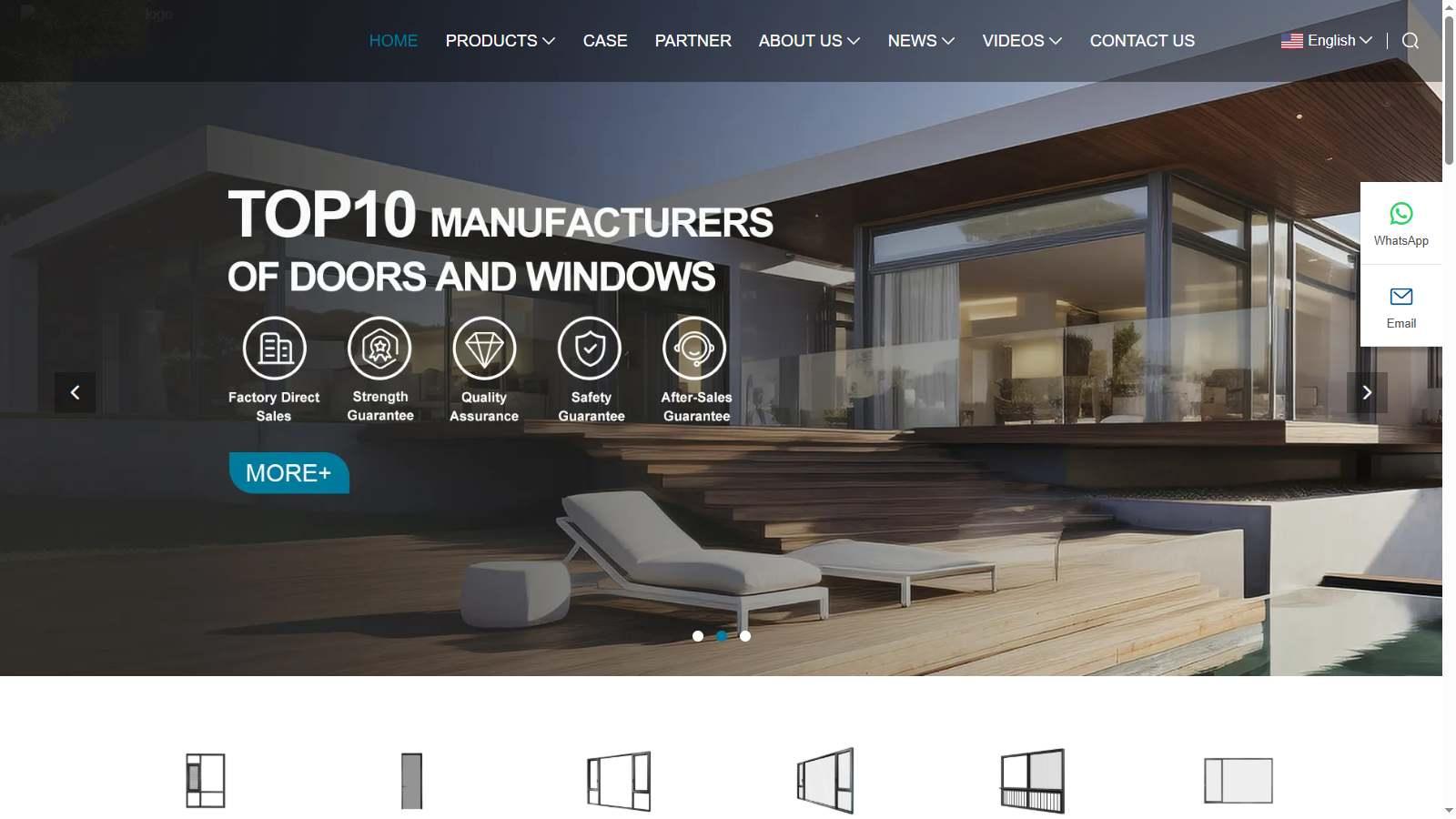
Headquarters / Supply Model: Foshan Angle Doors and Windows Co., Ltd., founded in 2003 and based at No. 30 Honggang Industrial Zone, Lishui Town, Nanhai District, Foshan. Reports three production bases with a total area of 200,000 m² after a 2023 expansion, plus a 2,500 m² marketing centre.
Core Products / Technologies: Inward Opening Aluminum Frame Casement Windows appear in the featured product list, alongside outward casement, tilt and turn, sliding, slide-and-press, tilt-and-slide and intelligent lifting windows, plus casement doors, folding doors and sunrooms. Project references include villa and palace work in Qatar and Kuwait.
Why Consider Angle: The company covers inward and outward opening casement in the same catalog, which is practical when a facade needs both — inward opening for ventilation in living areas, outward opening where interior space is tight. The Middle East project references suggest experience with large openings and high wind loads.
Best Suited For: Villa and hospitality projects that mix inward and outward opening windows across one facade, and buyers who want a single supplier for both.
Before Purchasing: Published area and output figures are internally inconsistent, so confirm capacity in writing. Confirm whether the inward opening casement is offered as a double-leaf unit and what hardware it uses, and request test data at the sash size you need.
6. Zhengji Windows & Doors
Website: https://zhengjiwindows.com/
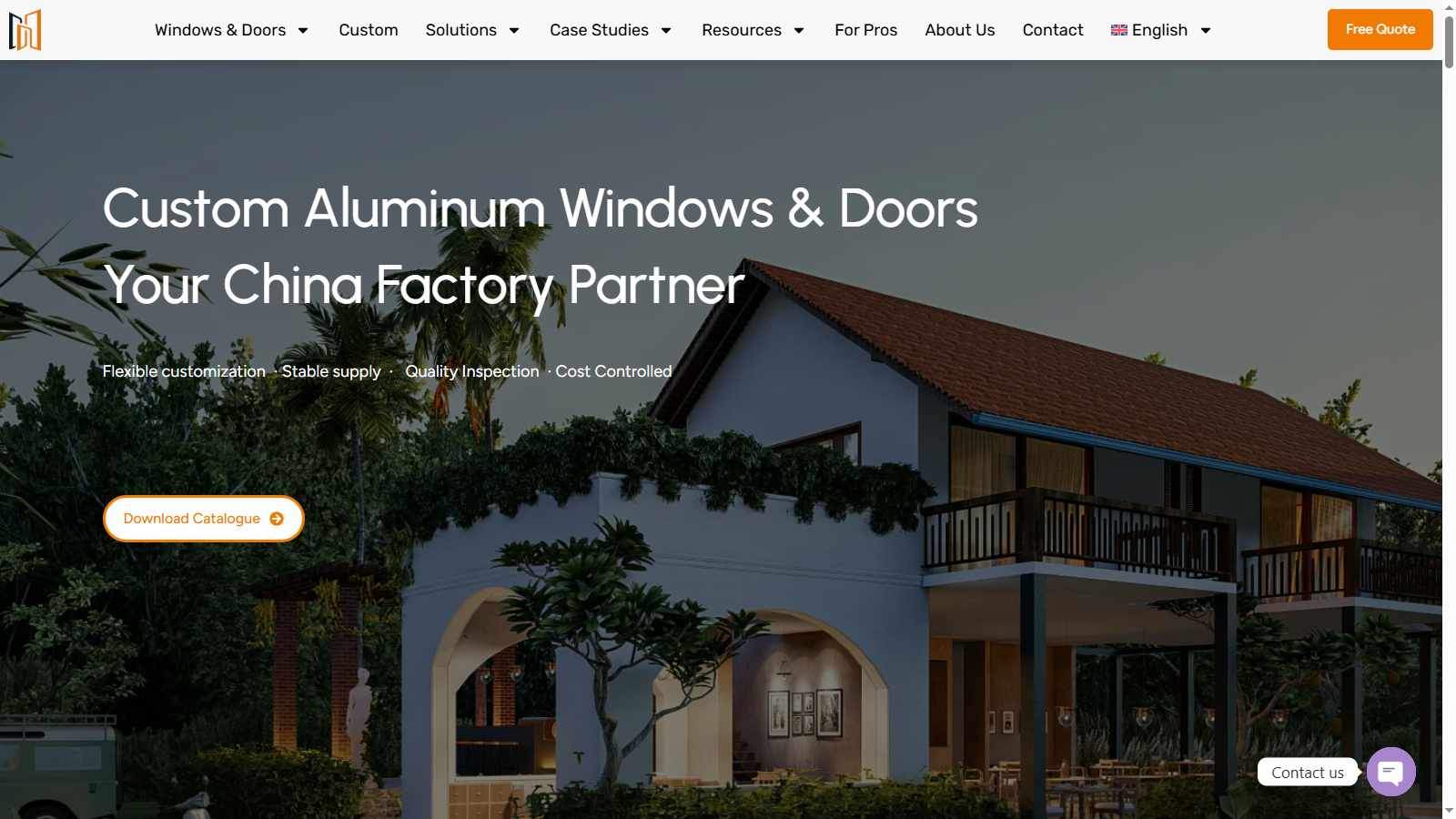
Headquarters / Supply Model: A manufacturing-based company specialising in custom aluminum windows and doors, with a stated 80,000 m² manufacturing area, 300+ skilled workers, 11 production workshops and an annual output figure of 30,000 tons. Works as a factory partner for overseas buyers.
Core Products / Technologies: A Tilt and Turn Window positioned as a premium inward-opening system for ventilation, cleaning access and energy-focused projects, alongside sliding windows and other custom aluminum systems. The company describes its certification strategy as developed progressively against target markets.
Why Consider Zhengji: Eleven workshops and 80,000 m² make this one of the larger custom-focused factories in this list, and the inward-opening tilt-and-turn system is described in terms of its use cases — ventilation, cleaning access, energy performance — rather than just its name. That orientation suits buyers who need to justify the specification to an architect.
Best Suited For: Custom residential and light commercial projects where tilt-and-turn inward windows are specified individually rather than as a standard catalog item.
Before Purchasing: No address or city is published and no certificates are named, so confirm the factory location and request whatever market certification you need before relying on the company's compliance. Ask specifically whether the tilt-and-turn system can be supplied as a double-leaf unit.
7. GONHO (Foshan Beilu Doors and Windows)
Website: https://www.gonhowindows.com/
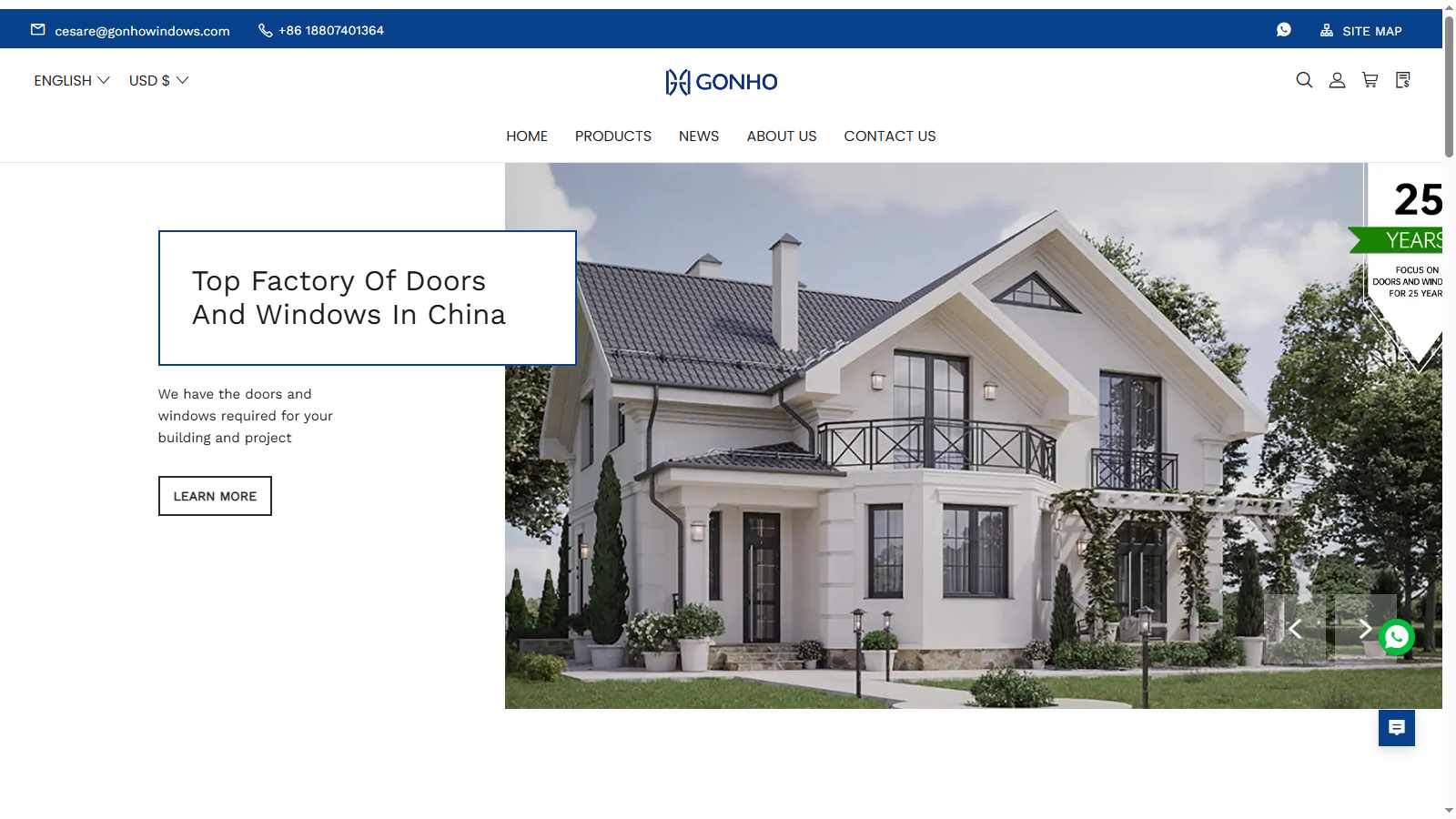
Headquarters / Supply Model: GONHO is the brand of Foshan Beilu Doors and Windows Co., Ltd., based in Shishan Town, Nanhai District, Foshan, with more than 25 years in the door and window business. Operates as a brand company integrating development, design, production and service.
Core Products / Technologies: An inward opening tilt-and-turn window marketed on sealing and environmental performance, listed among the company's hot products. The wider range covers standard casement, sliding and fixed systems for residential projects.
Why Consider GONHO: Twenty-five years in the Foshan cluster means the supply relationships and tooling are settled, and the inward opening tilt-and-turn unit is presented as a hot product rather than a special order — which usually means the hardware is stocked and the assembly process is stable. It is a reasonable option for buyers who want a proven inward-opening system without a large-brand price premium.
Best Suited For: Distributors and residential project buyers looking for a proven inward opening tilt-and-turn unit from an established Foshan brand.
Before Purchasing: The company publishes almost no scale data — no factory area, staff count or capacity — and no named certifications, so request the factory audit information and the test reports you need. Confirm the hardware brand and whether double-leaf configurations are available.
8. LEAWOD (Golden Power Building Materials)
Website: https://www.leawodgroup.com/
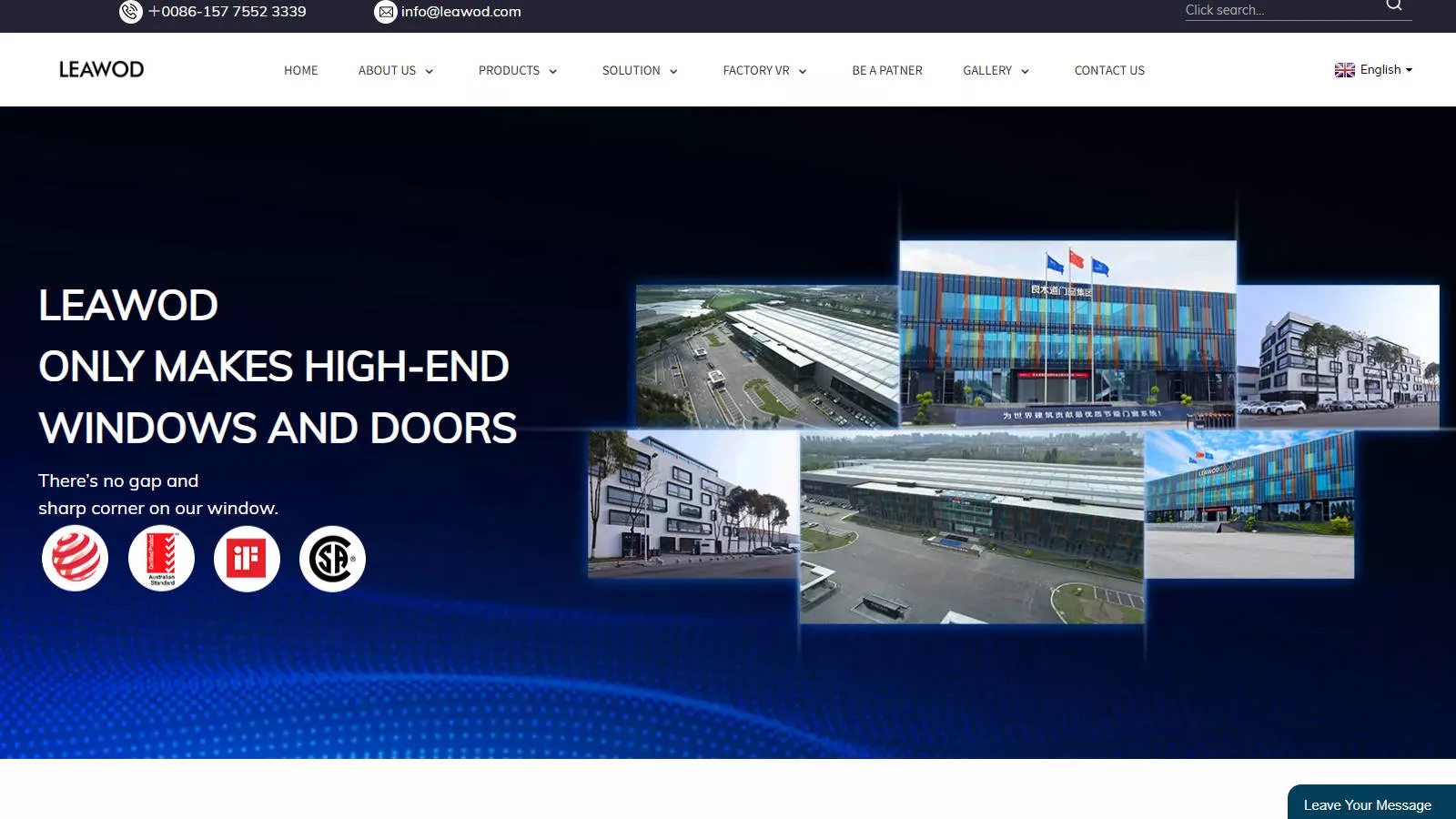
Headquarters / Supply Model: LEAWOD operates under Golden Power (Fujian) Building Materials, with a stated plant area of 178,000 m², capacity of 1.2 million m², 200+ window systems and 145+ national patents including more than 20 invention patents. Positions itself in the premium segment.
Core Products / Technologies: A GLN80 tilt-and-turn window within a 200+ system catalog, built around a seamless-weld corner construction that the company markets as its quality signature. The range also covers thermal break aluminum exterior doors, casement and sliding systems.
Why Consider LEAWOD: The system count is the practical advantage: with 200+ systems, a matching platform usually exists for an inward-opening opening rather than forcing one series onto every facade. Corner and joint quality matters on inward-opening sashes because the sash is the part that has to seal against the frame, and the seamless-weld construction is aimed directly at that joint.
Best Suited For: Distributors and project buyers sourcing premium-positioned aluminum windows in volume, where visible joint quality is part of the sales argument.
Before Purchasing: Treat the seamless-weld claim as a positioning statement and confirm whether the GLN80 tilt-and-turn series uses welded corners or mechanical crimping. Confirm that the inward-opening unit can be supplied as a double-leaf configuration, and ask for the hardware brand and test reports.
9. GY Windoor (Guangya Curtain Wall & Window Door)
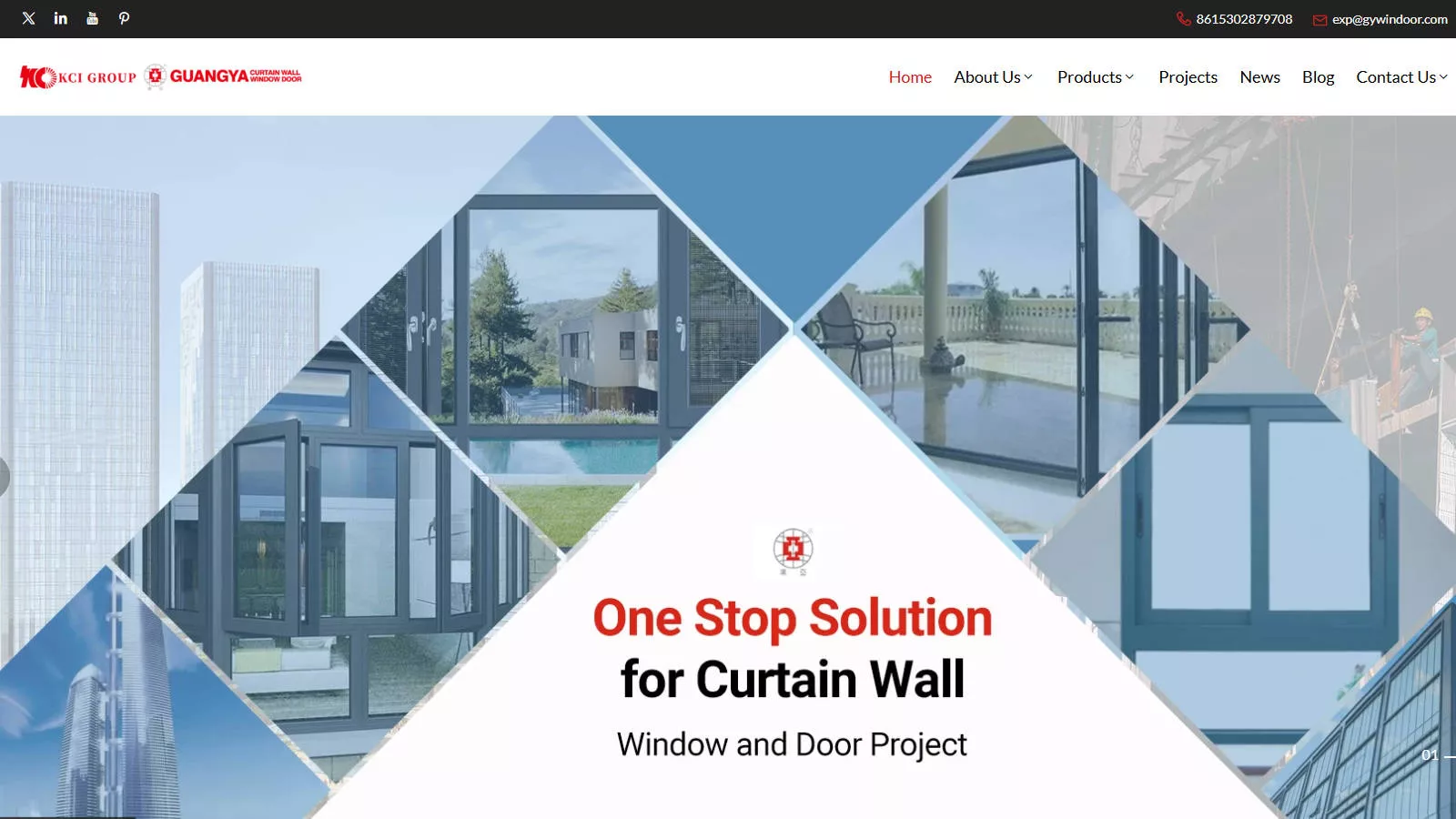
Website: https://www.gywindoor.com/
Headquarters / Supply Model: Guangya Curtain Wall & Window Door System Engineering Co., Ltd., based in Shishan Town, Nanhai District, Foshan, with a 40,000 m² facility and an annual production volume stated at 200,000 m². Certifications include ISO 9001, CQC and SAI Global AS2047.
Core Products / Technologies: Inward opening aluminum casement windows within a range built mainly around curtain wall, window wall and aluminum profiles, supported by in-house design and production of windows, doors and curtain wall systems.
Why Consider GY Windoor: The AS2047 certification is the differentiator for Australian buyers, and the company's curtain wall background means it is comfortable with large, multi-storey facades where inward-opening windows sit within a bigger envelope. If your project pairs inward casement windows with a curtain wall package, sourcing both from one supplier simplifies interfaces.
Best Suited For: Commercial and mixed-use projects that combine inward opening casement windows with curtain wall, especially where AS2047 documentation is required.
Before Purchasing: Curtain wall is the main business, so confirm how much of the casement window range is standard production versus project-specific fabrication. Ask for the AS2047 scope and the hardware used on the inward opening units.
10. ALUWF (Foshan NF Windows and Doors System)
Website: https://www.aluwf.com/
Headquarters / Supply Model: Foshan NF Windows and Doors System Co., Ltd., based in Nanhai District, Foshan, operating a 7,000 m² production area. Works on aluminum, wood-clad aluminum and uPVC windows and doors for export markets.
Core Products / Technologies: Tilt-and-turn window systems alongside bifold, casement and fixed windows in aluminum, wood-clad aluminum and uPVC. Certifications cited include ISO 9001, ISO 14001, GB/T 28001, CE, NFRC and SAI Global AS2047.
Why Consider ALUWF: The certification set is broad for a factory of this size — NFRC and AS2047 alongside CE — which helps if you are shipping to more than one market from a single order. Offering aluminum, wood-clad aluminum and uPVC in the same factory is also useful when a project needs inward-opening windows in more than one material.
Best Suited For: Export distributors who need inward-opening tilt-and-turn windows with multi-market documentation and the option of wood-clad or uPVC alongside aluminum.
Before Purchasing: At 7,000 m², capacity is limited — confirm the lead time for your volume. Ask whether the tilt-and-turn system is offered as a double-leaf unit, and request the specific certificate numbers and the sash sizes they cover.
Cost of Sourcing Double Inward Opening Windows from China
Double inward opening windows cost more than a single casement of the same size, because the hardware has to coordinate two leaves, a central mullion and a tilt mechanism. The table below shows what drives the number.
| Cost Factor | Why It Moves the Price |
|---|---|
| Tilt-and-turn hardware | Two leaves need two hardware sets plus a coordinated locking sequence. Branded European hardware can dominate the unit price on large sashes. |
| Sash weight and size | Inward-opening sashes are limited by hinge capacity. Oversized leaves require heavier hinges and thicker profiles, and may need a different opening concept entirely. |
| Profile series | A 70 series and a 90 series differ in thermal break width, chamber count and price. Passive-house-grade profiles sit at the top of the range. |
| Glazing build-up | Triple glazing, warm-edge spacers and laminated safety glass raise cost and weight, and the extra weight feeds directly into hinge selection. |
| Micro-ventilation or integrated screen | Trickle ventilation, insect screens and internal blinds add components and assembly time, and complicate the sealing design. |
| Certification and testing | Passive-house components, NFRC, AS2047 or CE documentation require tested configurations and add cost that is priced into the order. |
| Finish | Special RAL colours, anodizing, electrophoresis and wood-grain foils change price and lead time, especially on small batches. |
| Packing and logistics | Inward-opening sashes ship with hardware protruding; export crating and protection affect damage rates and landed cost. |
FAQs – Double Inward Opening Aluminum Windows
What does "double inward opening" mean exactly?
It means two window leaves that both open into the room, usually hinged on the outer frame with a central mullion between them. The leaves may be plain casement (side-hinged) or tilt-and-turn, which adds a tilt position for ventilation. Confirm which mechanism you are buying, because the hardware and the price differ substantially.
Why choose inward opening instead of outward opening?
Inward-opening sashes are easier to clean from inside, are not exposed to wind load on the hinge side, and allow larger leaves because the hinge carries the weight in compression rather than in tension. The trade-off is that the open sash occupies interior space, so furniture layout matters.
Can Chinese manufacturers supply passive-house-grade inward windows?
Yes. Several factories build inward-opening casement systems aimed at passive-house performance, and some hold component certification. Ask for the certificate number and confirm it covers the exact frame, glazing and size you are ordering — a certificate for a different configuration does not transfer.
What hardware should I specify for a two-leaf system?
Ask for the hardware brand, the hinge load rating per leaf, and whether the locking sequence is coordinated across both leaves. On double-leaf units the active and passive leaves must close in a defined order, and cheap hardware often fails at exactly that point.
What is the maximum sash size for an inward opening leaf?
It depends on the hinge system and the sash weight rather than a single number. Typical residential leaves run to roughly 1.2–1.5 m wide, but larger leaves are possible with heavier hardware. Always ask for the manufacturer's rated sash weight rather than a size alone.
Which tests should I request?
Air permeability, water tightness and wind load resistance for the double-leaf configuration, referenced to GB/T 7106, EN 12207/12208/12210, AS 2047 or AAMA/NFRC depending on your market. Also ask for the acoustic rating if the project faces a road.
How long does production take?
Lead time depends on profile stock, hardware availability, glazing and finish, and commonly runs from several weeks to a few months for custom double-leaf systems. Confirm the schedule against your installation date, not the shipment date.
Can I mix inward and outward opening windows in one order?
Yes, and several manufacturers in this list build both. Mixing is common on villas, where living areas use inward opening for ventilation and smaller rooms use outward opening to save interior space. Confirm that both types share the same profile family so the facade looks consistent.
Who Is the Best Double Inward Opening Aluminum Window Manufacturer?
There is no single "best" manufacturer here, because a double inward opening window is a system, not a commodity: the hardware, the sash weight rating and the sealing design decide whether it performs after five years. A distributor building a catalog and a contractor fitting out a passive-house villa should weigh different things.
For buyers who need inward-opening casement windows as part of a broader facade package, Taiyang is a strong option to shortlist. Its BD93 Passive House Inward Opening Casement Window sits in a catalog that also covers outward-opening thermal break windows, panoramic sliding doors, pivot doors and curtain wall, so a mixed facade can be documented under one ISO 9001/14001/45001 system from a 21,193 m² factory in Nantong, Jiangsu — which is particularly relevant for developers coordinating several opening types on one project.
When you request a quote from Taiyang, include the following parameters so the engineering team can return an accurate, comparable offer: leaf configuration (single or double, active/passive arrangement), opening mechanism (casement or tilt-and-turn), sash width, height and weight per leaf, profile series and thermal break width, glazing build-up and Ug value, target Uw, air and water class with the standard referenced, wind load and building height, hardware brand and hinge rating, screen or micro-ventilation requirement, surface finish and RAL colour, quantity and size schedule, project location and climate zone, and your required delivery window.


