
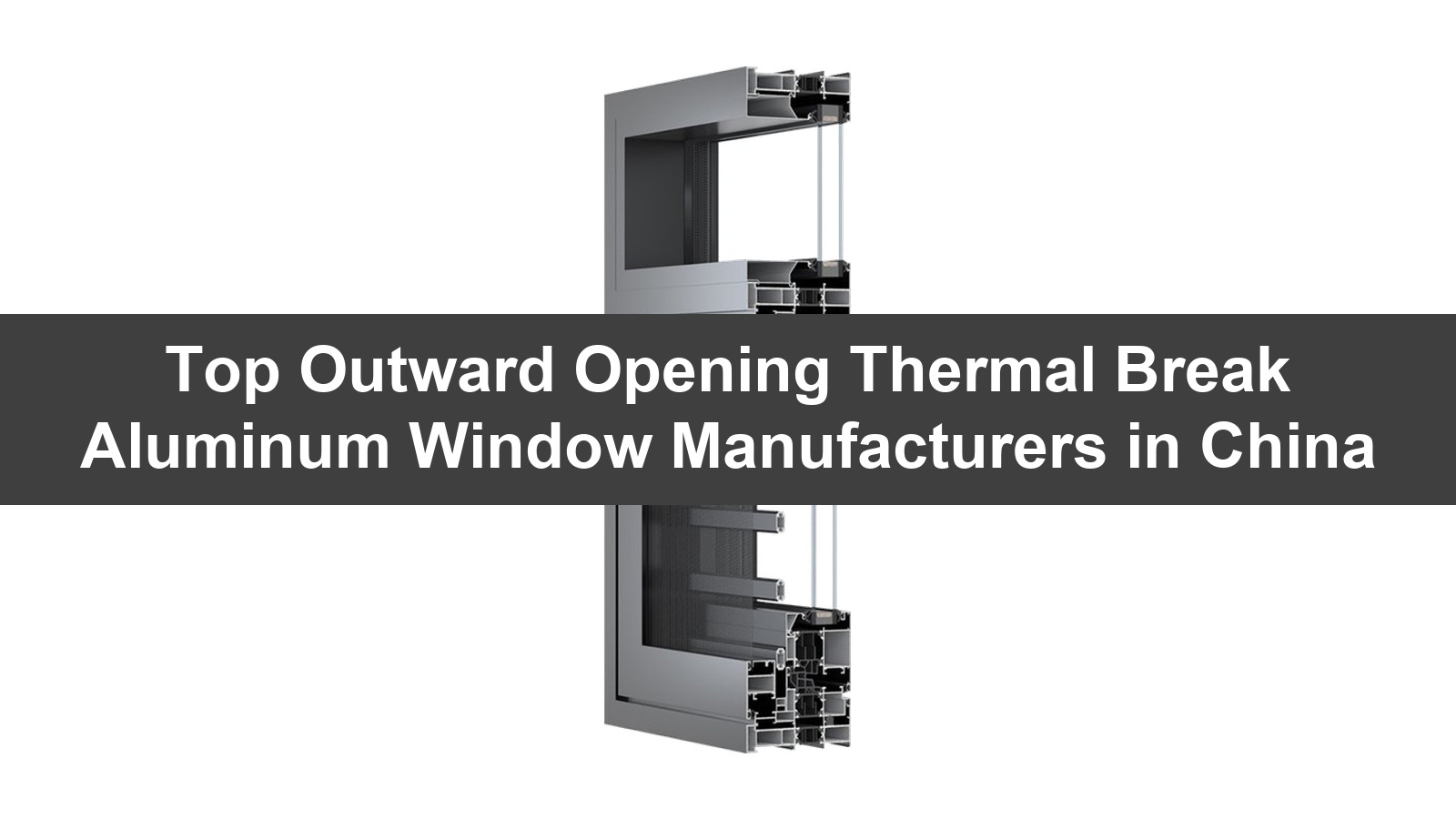
Are you looking for outward opening thermal break aluminum windows that combine real thermal performance with dependable weather sealing? Do you want to find a China manufacturer that offers a defined casement system, tested air and water performance, and export-ready documentation? Or are you hoping to source customized outward-opening sashes with the right hardware, restrictors and glazing for your market?
If the answer is yes, then China is your best choice. China boasts a mature aluminum window and door supply chain, from extrusion and polyamide thermal-break strips to hardware, glazing and finished fabrication, which is why so many overseas distributors and project buyers source outward opening thermal break aluminum windows here. Below, we present leading outward opening thermal break aluminum window manufacturers in China to help you quickly find the right partner.
Quick Navigation
- Taiyang (Taiyang Window & Door)
- Shandong Dazheng (Dazheng Windows & Doors)
- HTS-ALU
- China Loong Door-Window
- Sainty Aluminum
- SGL Doors & Windows
- LEAWOD (Golden Power Building Materials)
- JL Aluminum (JL Group)
- Lolands (Foshan Lolands Doors & Windows)
- BROAD (BROAD Windows & Facade Limited)
1. Taiyang (Taiyang Window & Door)
Website: https://www.taiyangwindowdoor.com/
Headquarters / Supply Model: China-based thermal break aluminum window, door and curtain-wall manufacturer founded in 2003, operating a 21,193 m² facility with a stated monthly capacity of about 20,000 m² and a workforce of 360+. Supplies project buyers, distributors and OEM customers from drawing review through export packing.
Core Products / Technologies: The catalog names an outward-opening thermal break aluminum window system (ES110) alongside a thermal break window with integrated insect screen (BF115) and a passive-house inward-opening casement (BD93). The wider range covers panoramic and sliding doors in lift-and-slide and standard configurations, aluminum sunrooms in flat-roof, pitched-roof and lean-to forms, and unitized or stick-built curtain wall. Thermal break windows are stated as tested to GB/T 7106.
Why Consider Taiyang: For this specific product category, the value is that the outward-opening thermal break window is a named system rather than a generic "casement" line, so a buyer can request performance data, sash limits and hardware specs against a defined platform instead of starting from a blank sheet. Manufacturing is backed by ISO 9001, ISO 14001 and ISO 45001 management systems, 100+ original patents, and a reported 100+ completed projects with 49 in progress. The documented four-stage workflow (technical drawing, sample confirmation, production and inspection, export packing) is useful when you need the same sash repeated across a multi-building project.
Best Suited For: Distributors, façade contractors and developers specifying outward-opening thermal break casement windows for villas, high-rise residential and commercial buildings, and buyers who prefer to consolidate windows, doors, sunrooms and curtain wall with one factory.
Before Purchasing: Ask for the GB/T 7106 report that matches your exact sash size and glazing build-up, not a generic series report. Because outward-opening sashes are exposed to wind load on the hinge side, confirm the friction stay or restrictor specification, the maximum sash weight per hinge set, and whether a screen or louver option is required. Also confirm the aluminum profile series, the polyamide strip width and the hardware brand before comparing prices.
2. Shandong Dazheng (Dazheng Windows & Doors)
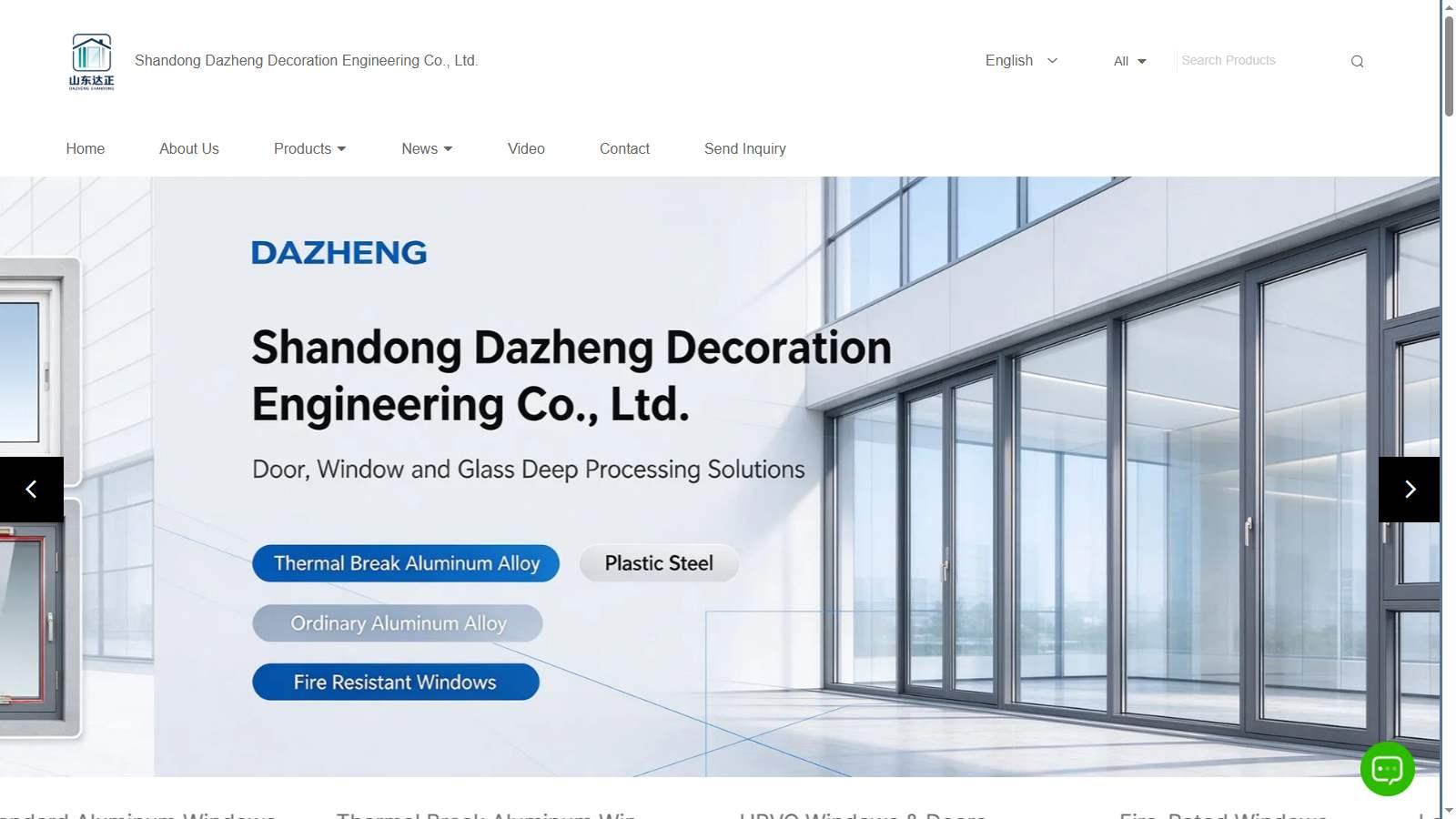
Website: https://www.sddzwindow.com/
Headquarters / Supply Model: Shandong Dazheng Decoration Engineering Co., Ltd., founded in 2008 and formerly Binzhou Jinghui Insulated Glass Factory, based in the Zaohuli Town Industrial Park, Huimin County, Binzhou, Shandong. The site covers more than 10,000 m² with 7,300 m² of workshops and 150+ employees, and runs two aluminum lines, two PVC lines and two insulating-glass lines plus tempering and lamination equipment.
Core Products / Technologies: A 50-series thermal-break outward casement and sliding range, a 45-series thermal-break awning window, 53-series thermal-break sliding, inward and awning systems, UPVC outward-opening casement windows, and fire-rated windows carrying a one-hour fire-resistance type test report. Standard aluminum casement windows and louvered windows complete the range.
Why Consider Dazheng: The product naming is unusually explicit for this category — the 50-series is described directly as a thermal-break outward casement system, which makes specification and comparison easier. Glass is processed in-house, so tempered, laminated and insulating units are made on the same site as the frames, shortening the chain between profile, glazing and finished sash. The company also holds a Grade II qualification for fabrication and installation of building doors and windows in China, and states annual processing capacity above 200,000 m².
Best Suited For: Buyers who need thermal-break outward casement windows plus fire-rated or special glazed units from a single factory, and projects where glass quality control at source matters more than a wide decorative catalog.
Before Purchasing: The stated export share is small (1%–10%), so confirm export-grade crating, documentation and any CE, AS2047 or NFRC testing your market requires before assuming export readiness. Ask which series carry current test reports, request the hardware brand and restrictor type used on outward-opening sashes, and check the quoted lead time against the roughly 200,000 m² annual capacity if your order is large.
3. HTS-ALU
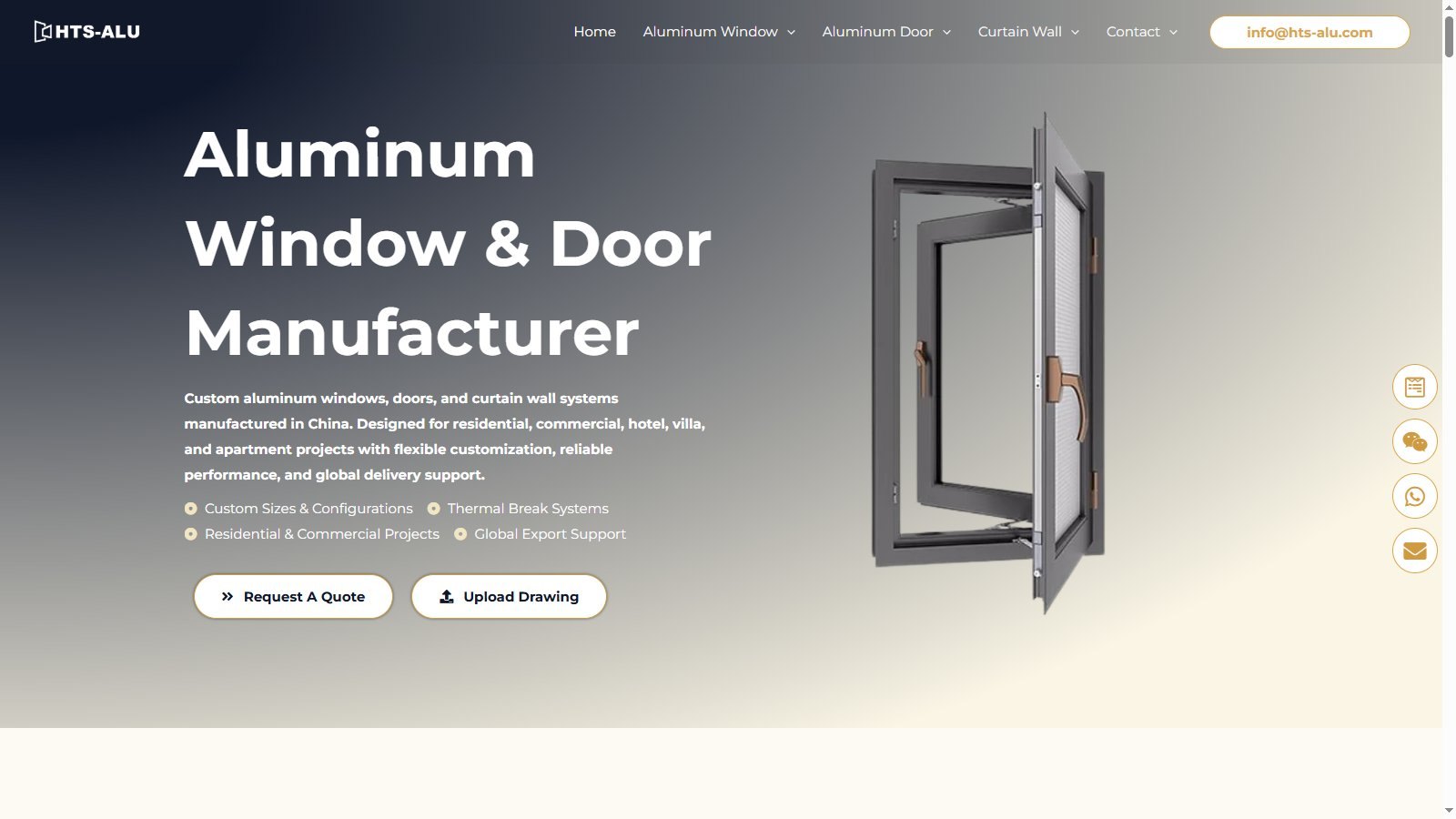
Website: https://windoor.hts-alu.com/
Headquarters / Supply Model: A China-based aluminum window, door and curtain-wall manufacturer with integrated profile production and fabrication, including automated CNC cutting, machining and precision corner assembly. The company supplies distributors, contractors, builders and developers, and offers both fully assembled and knock-down supply.
Core Products / Technologies: Casement windows described as side-hinged units that open outward or inward, plus awning, sliding, hung, folding and fixed windows, and French, folding, pivot and sliding doors. Systems use thermal-break profiles with glazing options including double or triple glazing, tempered, laminated and Low-E glass, and hardware from CMECH, HOPO or ROTO. Finishes include anodizing, RAL powder coating, electrophoresis and wood grain, with sound reduction stated up to 45 dB on suitable configurations.
Why Consider HTS-ALU: The site explains the outward-opening casement mechanism explicitly, which matters when you are comparing suppliers who use the word "casement" loosely. Integrated profile production means the profile, surface finish and fabrication come from one chain rather than three separate vendors. Purchasing terms are also flexible for a factory of this type — MOQ from one unit, knock-down or assembled delivery, with or without glass, and air freight for samples — which suits distributors who want to validate a system before committing to a container.
Best Suited For: Distributors and contractors who prefer sample-first purchasing and KD supply, and buyers consolidating windows, doors and curtain wall with one manufacturer.
Before Purchasing: The certification wording is that systems "can be configured to meet" NFRC, AAMA, AS2047, CSA or CE requirements, which is not the same as blanket certification of every line. Confirm which certificate covers the exact outward-opening system, sash size and glazing you intend to order. For knock-down supply, ask for assembly drawings, the gasket and hardware kit list, and a clear statement of how warranty is handled after local assembly.
4. China Loong Door-Window
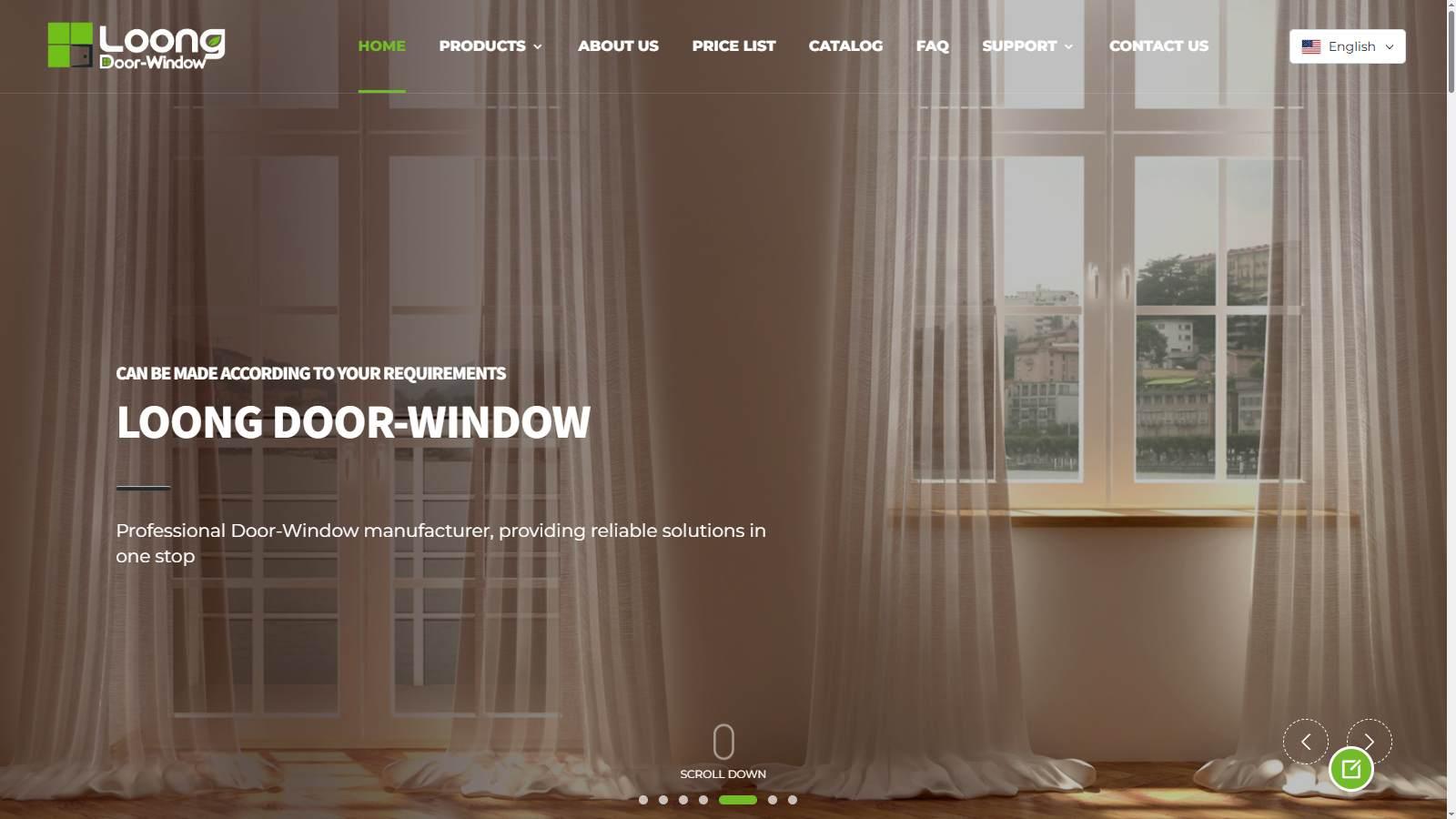
Website: https://www.china-doorwindow.com/
Headquarters / Supply Model: China Loong Door-Window Co., Ltd. describes itself as a manufacturer and supplier of architectural doors and windows for residential, commercial and selected industrial applications, with 8,000 m² of production space, 86+ production and technical staff and 15+ years of manufacturing experience. OEM and ODM cooperation are offered.
Core Products / Technologies: Broken-bridge (thermal break) aluminum windows sit alongside a dedicated outward-opening window category, plus casement, tilt-and-turn, top-hung, bottom-hung, fixed, bay, corner, curved, narrow-frame and system windows. The range extends to aluminum-clad wood, wood-clad aluminum, plastic-steel, fire-rated, sound-insulated, bullet-proof and explosion-proof windows, with casement and sliding doors in matching systems.
Why Consider China Loong: Catalog breadth is the differentiator. A distributor building a full price list can source outward-opening and broken-bridge aluminum windows together with specialty items such as fire-rated, sound-insulated or bullet-proof units from one supplier, which reduces the number of vendors and documentation sets to manage. Customization covers dimensions, configurations, glass, profiles, colors, hardware and opening methods, and the company states it supports private-label and mixed project orders.
Best Suited For: Distributors and private-label buyers who need a broad, coordinated range rather than a single high-performance platform, and project buyers mixing standard openings with special-performance windows.
Before Purchasing: The company presents itself as both manufacturer and supplier, so confirm which lines are produced in-house and which are sourced. Ask for the polyamide strip material (PA66 GF25 rather than PVC), the profile series behind the outward-opening range, and current test reports for the exact system. For private-label orders, confirm label, packaging and carton marking requirements early, since these affect lead time.
5. Sainty Aluminum
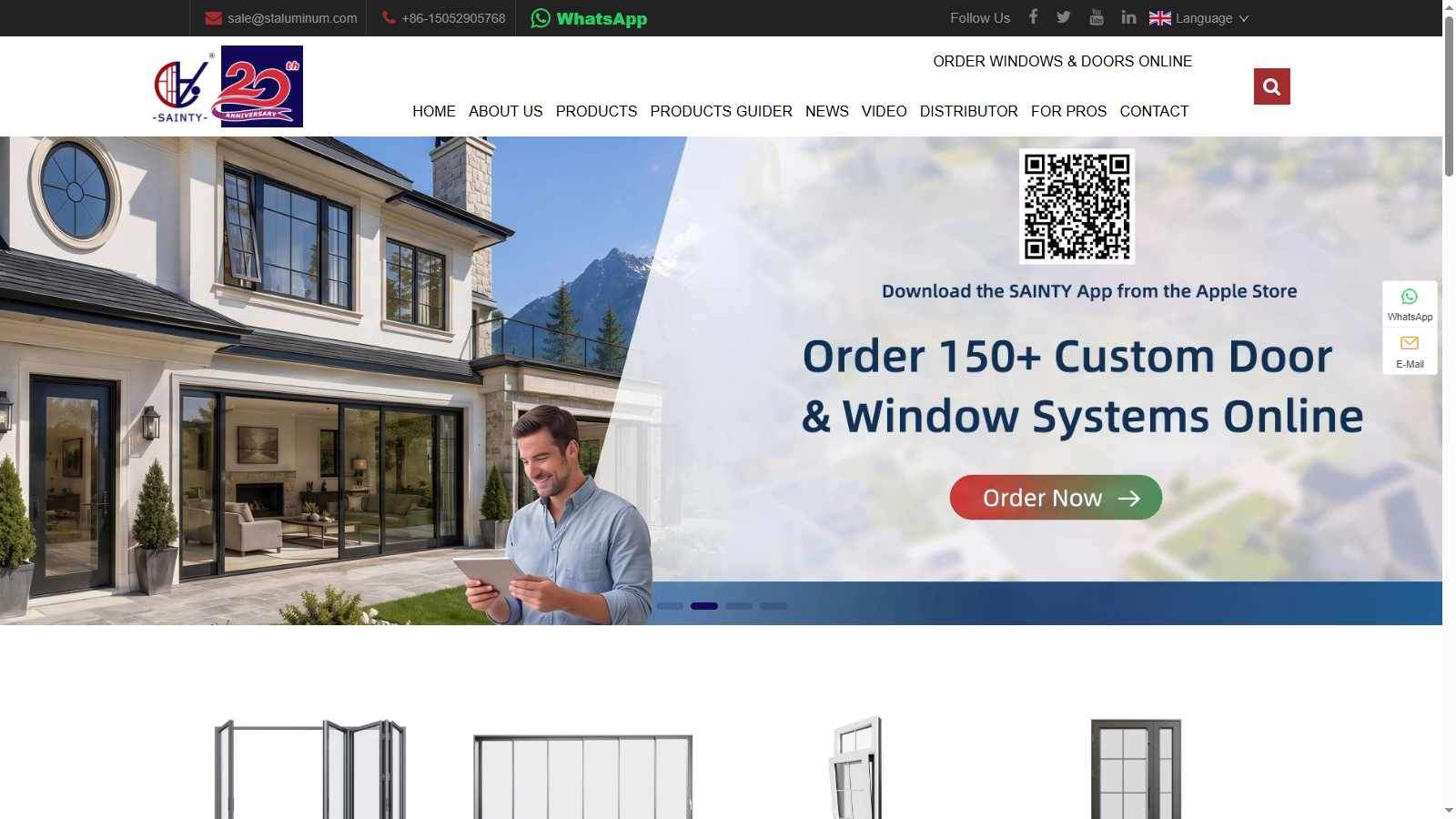
Website: https://www.aluminum-window.com/
Headquarters / Supply Model: Sainty Aluminum (ST Aluminum), established in 1995 and located at Baogou Town Industry, Tengzhou City, Zaozhuang, Shandong. The company reports a site of over 100,000 m² and about 1,000 staff, with 28 extrusion lines from 600 t to 6,400 t and roughly 6,000 t of profile output per month.
Core Products / Technologies: Aluminum billet and extrusion, architectural aluminum profiles, finished aluminum windows and doors, curtain wall, partitions and railings. Window and door fabrication is stated at about 5,000 m² per month, with certificates cited for NFRC (US), AWA (Australia), CSA (Canada), a German component standard and ISO. The company also states it operates a window and door performance testing laboratory.
Why Consider Sainty: Vertical integration from billet and extrusion through to finished windows means profile supply and window fabrication are controlled by one organization, which helps when you need a specific profile or a custom extrusion developed for your market. The NFRC, AWA and CSA references are meaningful for North American and Australian buyers who need a documented test path, and exports to 45+ countries suggest familiarity with different documentation packages.
Best Suited For: Buyers who want profile supply and finished thermal-break windows from one source, and export programs targeting the United States, Australia or Canada where test documentation is part of the purchasing decision.
Before Purchasing: Window fabrication output is modest relative to the extrusion capacity, so confirm the fabrication capacity and lead time available for your project volume rather than assuming profile capacity translates into window capacity. Confirm which certificate applies to the outward-opening thermal-break system you specify, and request the tested sash size, since certificates are configuration-specific.
6. SGL Doors & Windows
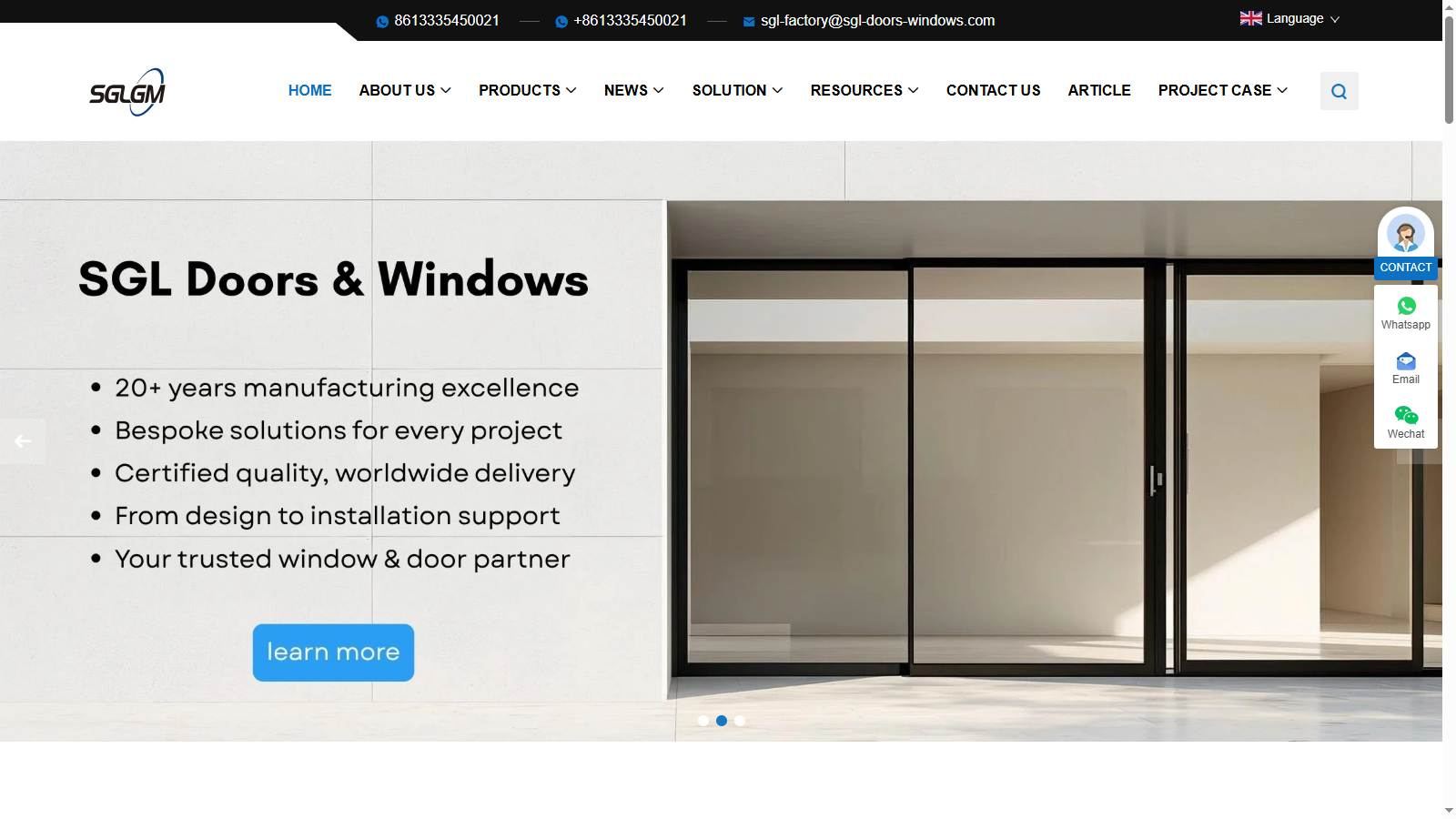
Website: https://www.sgl-doors-windows.com/
Headquarters / Supply Model: Shaanxi SGL Doors & Windows Technology Co., Ltd., based in Hanzhong City, Shaanxi, and operating since 2006. The company runs three production bases of roughly 9,000 m² each with 200+ employees, states annual capacity above 100,000 sets, and combines in-house manufacturing with integration of China's wider door and window supply chain.
Core Products / Technologies: A named SGL 110 integrated casement window system, plus aluminum casement windows including triple-glazed and wood-grain finishes, UPVC windows, folding doors, fire-rated and soundproof systems. Production includes two aluminum window lines, one aluminum door line, one PVC line and an in-house tempered glass line.
Why Consider SGL: The 110 integrated casement system gives a defined platform to specify and compare, which is more practical than evaluating a generic casement quote. Three bases and an in-house tempered glass line support repeatable volume, and a R&D team led by 10 senior engineers working on profile structure and energy performance suggests the systems are actively developed rather than catalog-copied. Since 2021 the company has built export experience across North America, Europe, the Middle East, Central Asia and Africa.
Best Suited For: Contractors and wholesalers who want a defined casement platform alongside a broad material range (aluminum, UPVC, steel, glass) and whole-house customization for residential projects.
Before Purchasing: Confirm whether the 110 system is configured as outward or inward opening, and which thermal-break strip and hardware it uses. Because the business model combines in-house production with supply-chain sourcing, ask for the production origin of each specified system and clarify who issues the warranty when items come from partner factories.
7. LEAWOD (Golden Power Building Materials)
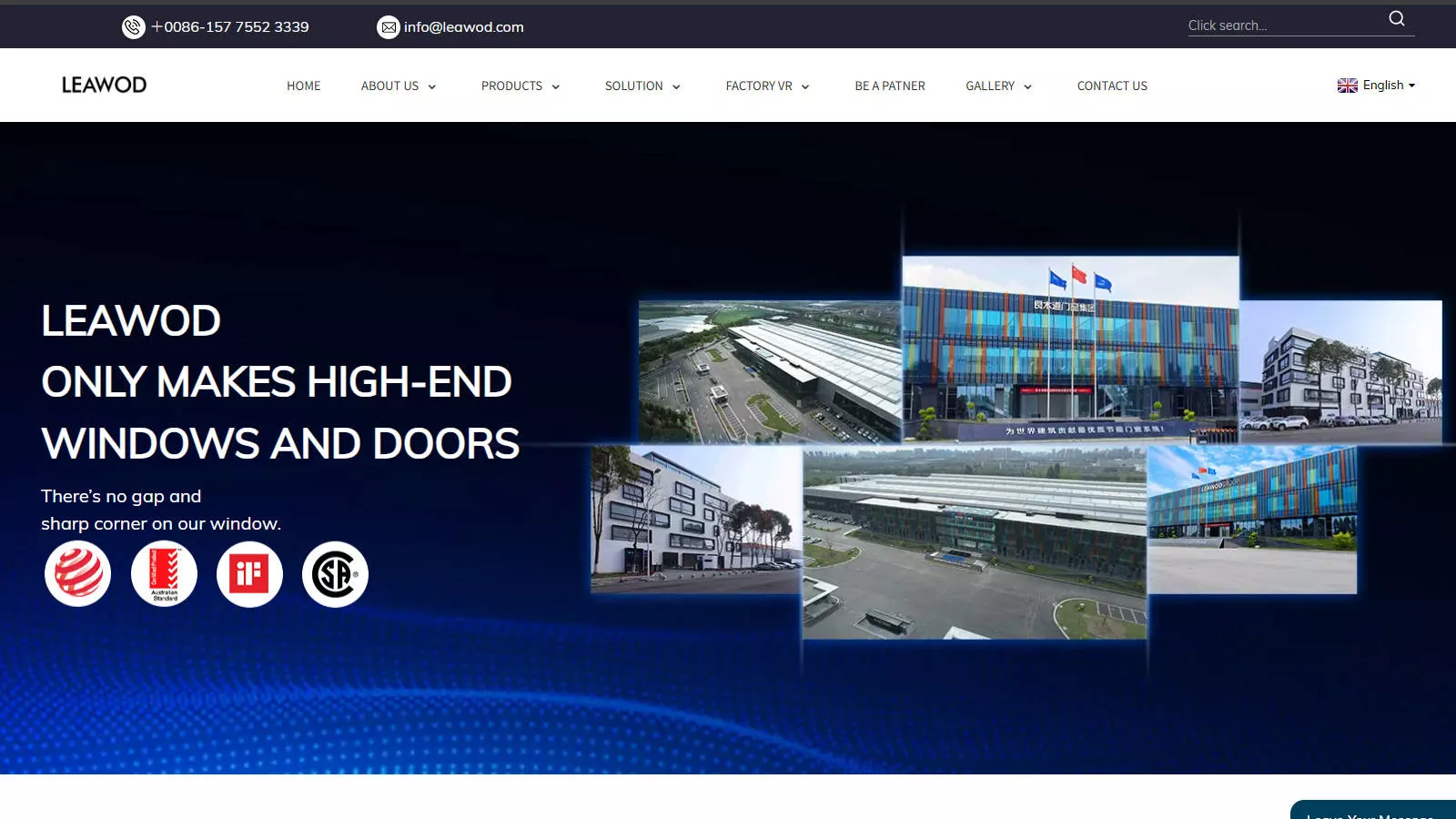
Website: https://www.leawodgroup.com/
Headquarters / Supply Model: LEAWOD operates under Golden Power (Fujian) Building Materials and positions itself as a high-end window and door manufacturer. The company states a total plant area of 178,000 m², capacity of 1.2 million m², 200+ window systems, and 145+ national patents including more than 20 invention patents.
Core Products / Technologies: Aluminum windows and doors built around a seamless-weld corner construction that the company markets as its quality signature, together with thermal break aluminum exterior doors and casement and sliding systems. The range is organized as 200+ window systems intended to cover different building types and performance levels.
Why Consider LEAWOD: Scale and system depth are the main arguments — 178,000 m² of plant, 1.2 million m² of capacity and 200+ systems mean a buyer can usually find a matching platform rather than forcing a single series onto every opening. The corner-joining technology is relevant to outward-opening sashes specifically, because corner and joint quality on the opening sash is where water and air leakage usually starts.
Best Suited For: Distributors and project buyers sourcing premium-positioned aluminum windows and thermal break exterior doors in volume, especially where visible joint quality is part of the sales argument.
Before Purchasing: Treat the seamless-weld claim as a company positioning statement and confirm whether the specific outward-opening thermal-break series uses welded corners or mechanical crimping, since the two have different repairability and cost profiles. Ask for the profile series, thermal-break strip material, hardware brand and test reports for the system you intend to order, plus the export certification relevant to your market.
8. JL Aluminum (JL Group)
Website: https://www.aluminium-supply.com/
Headquarters / Supply Model: JL Group is an aluminum profile brand and window and door factory based in Foshan, Guangdong, with 22 years of OEM/ODM production experience. The factory covers 35,000 m², runs 10 extrusion lines and states annual capacity above 50,000 tons, offering extrusion, powder coating and finished door and window services.
Core Products / Technologies: Five architectural categories: aluminum profiles, aluminum glass curtain walls, aluminum doors and windows, aluminum railings and aluminum industrial profiles. The company supplies both raw and finished profiles and complete windows and doors, and describes a five-step OEM flow from inquiry and molding quote through sample approval, production and shipping.
Why Consider JL Aluminum: Profile-first integration is the practical advantage. If you are developing your own window system, need a custom extrusion, or want the profile and the finished window supplied under one quality system, this model removes the mismatch that occurs when a fabricator buys profiles from a third party. Twenty-two years of OEM/ODM work also means the factory is used to working from customer drawings rather than only selling a fixed catalog.
Best Suited For: Distributors and brands that want profile supply and finished window fabrication coordinated, and buyers developing a proprietary system with custom extrusions.
Before Purchasing: The company's primary identity is aluminum profile supply with window and door fabrication, so confirm the split between profile sales and finished window output, who owns the thermal-break system design, and whether the outward-opening sash is tested as a complete window unit rather than only as a profile. Ask for the surface treatment warranty terms separately from the window warranty.
9. Lolands (Foshan Lolands Doors & Windows)
Website: https://www.gdlolands.com/
Headquarters / Supply Model: Lolands operates from 20D Wenjiao Road, Lishui Town, Foshan, Guangdong, on a 30,000 m² production base with a 1,500 m² exhibition hall on site. The company presents itself as a manufacturer that integrates R&D, design, production and export of system windows and doors, with close to 20 years in the category and shipments to more than 154 countries.
Core Products / Technologies: Casement windows and casement doors sit alongside sliding windows, sliding doors, folding doors and skylights, and the range is positioned around thermal break aluminum systems with narrow sightlines. The company groups its performance claims under five headings – windproof, soundproof, waterproof, energy-saving and anti-rust – and lists multi-point locking, tempered glazing and precision frame assembly as standard construction points. Certifications shown on its own site include AS2047, NFRC, CE, CSA and ISO.
Why Consider Lolands: Two things stand out for an outward-opening buyer. First, casement windows and casement doors are core products rather than a line item added to a sliding-door catalogue, so the sash, hardware and restrictor package is already defined instead of being adapted after the order. Second, the export profile is unusually broad – more than 154 countries with named project references in Vancouver, Texas, Manila and Sydney – which means the factory has already met the documentation and packing expectations of several different markets, including both the AS2047 and NFRC frameworks.
Best Suited For: Distributors and project buyers who want an outward-opening casement system from a manufacturer with multi-market certification experience, and importers who need sliding and folding systems from the same source to complete a full opening schedule.
Before Purchasing: Confirm which of the listed certificates apply to the specific casement series you are ordering rather than to the company in general, and ask for the report number and the tested sash size. Because the range is wide, also confirm that the thermal break strip material and the profile wall thickness stay the same across the series you select, and agree the outward-opening restrictor and hinge specification in writing.
10. BROAD (BROAD Windows & Facade Limited)
Website: https://www.broadfacade.com/
Headquarters / Supply Model: BROAD Windows & Facade Limited runs a 20,000 m² plant with around 300 workers and 19 years of factory export service. The business combines window and door fabrication with facade work, so the same engineering team handles both punched openings and full curtain wall packages rather than handing one scope to a second supplier.
Core Products / Technologies: The catalogue covers thermal break casement doors, energy-saving aluminum casement doors, tilt-and-turn windows, lift-and-slide doors, commercial sliding doors and bi-folding doors, alongside curtain wall, glass louver and sunroom systems. The company states certification to CE, AS2047 and ISO 9001, audited by TUV and SAI Global, and offers a six-year quality warranty.
Why Consider BROAD: The facade capability is the differentiator. If a project mixes standard outward-opening windows with large glazed elevations, dealing with one supplier for both scopes removes the interface risk that appears when a window fabricator and a curtain wall contractor share a structural opening. Nineteen years of export work and named references in Australia, the United States, Bolivia and Venezuela also indicate experience with overseas site coordination, not only with factory supply.
Best Suited For: Contractors and developers who need outward-opening thermal break windows and facade glazing from one source, and buyers on projects where a six-year warranty and a third-party audited quality system form part of the tender requirement.
Before Purchasing: Ask which legal entity holds the AS2047 and CE certificates and whether the casement series you are quoting falls inside the tested scope. Because facade work is a large part of the business, confirm the production slot and lead time allocated to window-only orders, and clarify whether site measurement and installation support are included or quoted separately.
Cost of Sourcing Outward Opening Thermal Break Aluminum Windows from China
Outward-opening thermal break windows are quoted by configuration, not by window count, so two suppliers can return very different numbers for what looks like the same opening. The table below summarizes the factors that move the price most, so you can normalize quotes before comparing them.
| Cost Factor | Why It Moves the Price |
|---|---|
| Profile series and thermal break width | Deeper profiles and wider polyamide strips raise aluminum and strip cost but improve Uf and structural performance. A 50-series and a 70-series system are not interchangeable. |
| Sash size and wind load | Larger outward-opening sashes need heavier hardware, more hinges and thicker profiles; high-rise wind load requirements can push the whole system up a tier. |
| Hardware and restrictors | Friction stays, restrictors and multi-point locking are safety-critical on outward sashes. Branded European hardware can add a significant share to unit cost. |
| Glazing build-up | Double versus triple glazing, Low-E coatings, warm-edge spacers and laminated safety glass change both material cost and weight, which then affects hardware and freight. |
| Surface finish | Standard powder coat, special RAL colors, anodizing, electrophoresis and wood-grain foils differ in price and lead time, and some finishes carry different warranty terms. |
| Testing and certification | NFRC, AS2047, CE or project-specific test reports require tested configurations and documentation, which is priced into the order rather than offered free. |
| Order structure | Mixed small orders, many colors or many small sizes raise setup and handling cost; a consolidated project batch lowers unit price. |
| Packing and logistics | Export crating, corner protection and container loading method affect damage rates and landed cost more than the ex-works price suggests. |
FAQs – Outward Opening Thermal Break Aluminum Windows
What is an outward opening thermal break aluminum window?
It is a casement window whose sash is hinged on the frame and opens toward the outside, built on an aluminum profile that contains a polyamide insulating strip between the inner and outer profile halves. The strip interrupts the heat path through the metal, which is what allows the frame to deliver a meaningful thermal performance instead of conducting heat straight through.
Why choose outward opening over inward opening?
Outward-opening sashes do not consume interior floor space and usually give a tighter seal against wind-driven rain because the sash presses onto the frame from outside. The trade-off is that cleaning the outer glass is harder from inside, and the sash is exposed to wind load, so the hinge and restrictor specification becomes a safety issue on high-rise buildings. Inward-opening systems are easier to clean and better suited to very large sashes.
Can Chinese manufacturers meet European or North American standards?
Several manufacturers can supply systems tested to GB/T 7106 domestically and configured toward EN, NFRC, AAMA, AS2047 or CSA requirements. The important distinction is that certification applies to a tested configuration — a specific profile, sash size, glazing and hardware set — so always ask which certificate covers the window you are actually buying.
What should I specify for the thermal break itself?
Ask for the polyamide strip material (PA66 GF25 is the common standard, while PVC strips are cheaper and less durable), the strip width and the number of chambers in the profile. These details drive the Uf value and cannot be judged from a photo or a generic "thermal break" claim.
What is a typical minimum order and lead time?
Policies vary widely: some factories accept a single sample window, while others quote from a container or a project batch. Lead time depends on profile stock, surface finish, glazing and hardware, and commonly runs from several weeks to a few months for customized outward-opening systems. Confirm the schedule in writing against your installation date rather than the shipment date.
How do I verify air, water and wind performance?
Request the test report for the exact system and sash size, and check the tested values for air permeability, water tightness and wind load resistance. A report for a smaller fixed window does not validate a large opening sash, because the sash is the weakest point in an outward-opening design.
Can I customize colors, glass and hardware?
Most manufacturers offer RAL powder coating, anodizing, electrophoresis and wood-grain finishes, together with double or triple glazing, laminated glass and branded hardware. Confirm that the finish and hardware you choose are available on the specific outward-opening series, since some combinations are only validated on certain profile depths.
Should I buy assembled windows or knock-down kits?
Assembled units reduce site labor and preserve factory sealing quality, but cost more to ship. Knock-down supply lowers freight and is common for distributors who assemble locally, but it shifts responsibility for gaskets, corner joints and final water tightness to the importer. Confirm who warrants the assembled result in each case.
Who Is the Best Outward Opening Thermal Break Aluminum Window Manufacturer?
There is no single "best" manufacturer in this category, because the right partner depends on your sash sizes, wind zone, certification requirements and order structure. A distributor building a broad catalog will weigh range and OEM flexibility differently from a contractor who needs one tested outward-opening system repeated across a high-rise facade.
For buyers who want a defined outward-opening thermal break window system rather than a generic casement quote, Taiyang is a strong option to shortlist. The ES110 series is positioned specifically as an outward-opening thermal break window, the factory works under ISO 9001, ISO 14001 and ISO 45001 systems with 100+ original patents, and the same supplier can cover doors, sunrooms and curtain wall if your project needs more than windows — which is particularly relevant for developers and façade contractors coordinating several package types.
When you request a quote from Taiyang, include the following parameters so the engineering team can return an accurate, comparable offer: opening direction (outward casement, top-hung or tilt), sash width, height and estimated weight, preferred profile series and thermal break width, glazing build-up and Ug value, target Uw, wind load requirement and building height, required air and water tightness class, hardware brand and restrictor or friction stay preference, screen requirement, surface finish and RAL color, quantity and size schedule, project location and climate zone, and your required delivery window.


