
Are you looking for thermal break aluminum casement windows that will pass an energy code review rather than just a visual inspection? Do you need a supplier who can document U-values, air permeability and watertightness for the system you are actually buying? Or are you comparing quotations that look identical on paper but hide very different profile depths, break widths and hardware?
If the answer is yes, then the way you shortlist manufacturers matters more than the price per square metre. Thermal break casement windows are a system product: the polyamide strip, the chamber layout, the gasket sequence, the glass package and the hardware all decide whether the window performs in service. Two windows can share the same aluminium face width and behave completely differently at -10 °C. Below, we present leading thermal break aluminum casement window manufacturers in the world, with the details that actually distinguish them.
Quick Navigation
- Vancoor Entrance System
- Zhengji Windows & Doors
- JOLONG
- Taiyang
- LIKI Systems
- North Tech Windows
- Boyd Aluminum
- Donno Windows and Doors
- SGL Doors & Windows
- GKBM (Gaoke Building Materials)
1. Vancoor Entrance System
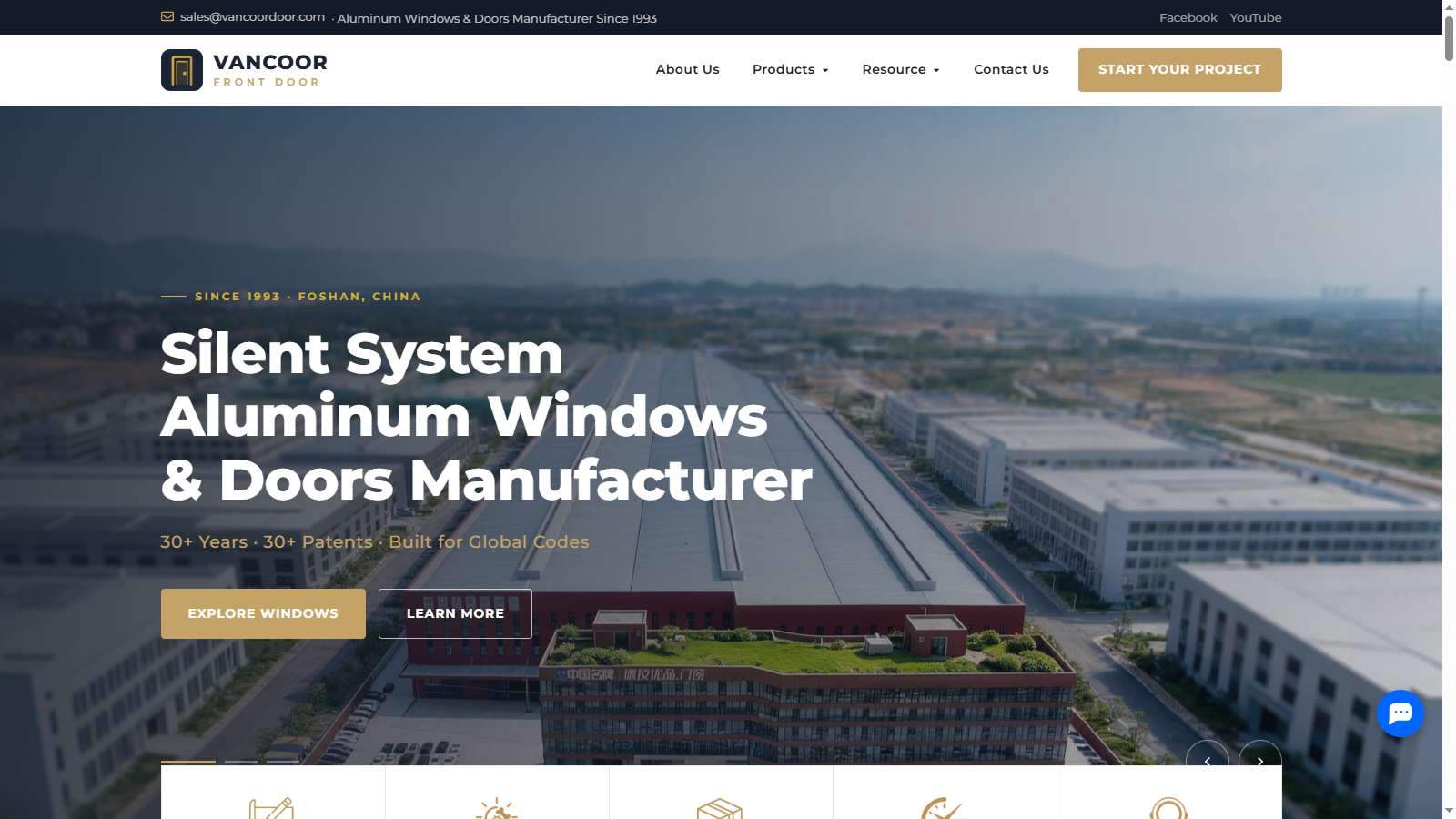
Website: https://www.vancoordoor.com/
Headquarters / Supply Model: A Foshan, China manufacturer of custom thermal break aluminium windows, doors and facade systems, established in 1993 and supplying importers, developers, architects and contractors directly from its own factory rather than through trading intermediaries.
Core Products / Technologies: Casement windows are listed as a core window type, described as inward or outward opening with a thermal break and multi-point locking. The range also covers sliding, tilt and turn, awning, bay and bow, picture, double-hung, bi-fold and impact windows, plus doors and facade systems. The company states a 50,000 m² production facility, a 5,000 m² showroom, an annual capacity of 500,000 units, 230+ employees and more than 30 patents, with profile selection, CNC machining, hardware integration, glazing and packing handled in-house.
Why Consider Vancoor: The offer is built around drawing-based customisation, which is what a casement project with mixed opening sizes needs: shop drawings are produced from the buyer's CAD or PDF plans before production, and the company states an average 4 to 5 week lead time after drawing approval. Market-specific compliance files are prepared for North America, Europe, and Australia and New Zealand, and each shipment can include test reports, material certificates, shop drawings and installation guides. For a distributor who needs a repeatable programme rather than a one-off container, the stated 98% on-time delivery rate and the presence of English-speaking project engineers reduce the usual communication risk.
Best Suited For: Importers and distributors running repeat container programmes, developers with multi-phase residential projects, and buyers who want one supplier for casement windows, doors and facade elements with a consistent finish.
Before Purchasing: Ask for the U-value of the complete window rather than the profile, and confirm which chamber and break width produces it. Request the air permeability, watertightness and wind resistance test reports for the exact series quoted, since certificates are issued per system. Clarify whether the quoted price includes glazing, hardware, screens and export packing, and who approves shop drawings before cutting starts.
2. Zhengji Windows & Doors
Website: https://zhengjiwindows.com/
Headquarters / Supply Model: A Chinese aluminium window and door manufacturer with more than 21 years of production experience, operating an integrated factory model in which extrusion, surface finishing, CNC machining, assembly, inspection and packing are completed in-house for OEM, private-label and project buyers.
Core Products / Technologies: Casement windows are positioned for residential, villa and light commercial use with an emphasis on sealing and ventilation control, alongside sliding, tilt and turn, top hung and louver windows, casement and sliding doors. The company states an 80,000 m² manufacturing area, 11 production workshops, 300+ employees and an annual extrusion output of 30,000 tonnes. Thermal break or non-thermal-break frame systems, double or triple glazing, Low-E, laminated and tempered glass, multi-point locking and RAL powder coating or anodising are all offered as configuration options.
Why Consider Zhengji: The strength here is repeatability for buyers who resell under their own brand. Because the critical steps sit inside one factory, the same profile, finish and hardware specification can be reproduced across batches, which is the usual failure point when a distributor scales from a sample order to a container programme. Published case studies include a multi-storey residential development at Aspern Seestadt in Vienna with thermal break casement and sliding windows, a London residential renovation using casement and top-hung windows with triple glazing, and a townhouse development in Minneapolis. The company also states that buyers can start a technical review with rough dimensions, a window schedule or a BOQ instead of finished drawings.
Best Suited For: Window companies and OEM brands building a private-label line, importers needing bulk supply with consistent specifications, and project buyers who want drawing review and inspection before shipment.
Before Purchasing: Confirm which certifications actually apply to the casement system you are buying, because the company states that certification is developed progressively by market rather than held as a blanket approval. Ask for the profile wall thickness, the thermal break strip material and width, and the hardware brand for the quoted configuration. Clarify MOQ, the sample or mock-up arrangement, and the inspection protocol before the deposit is paid.
3. JOLONG
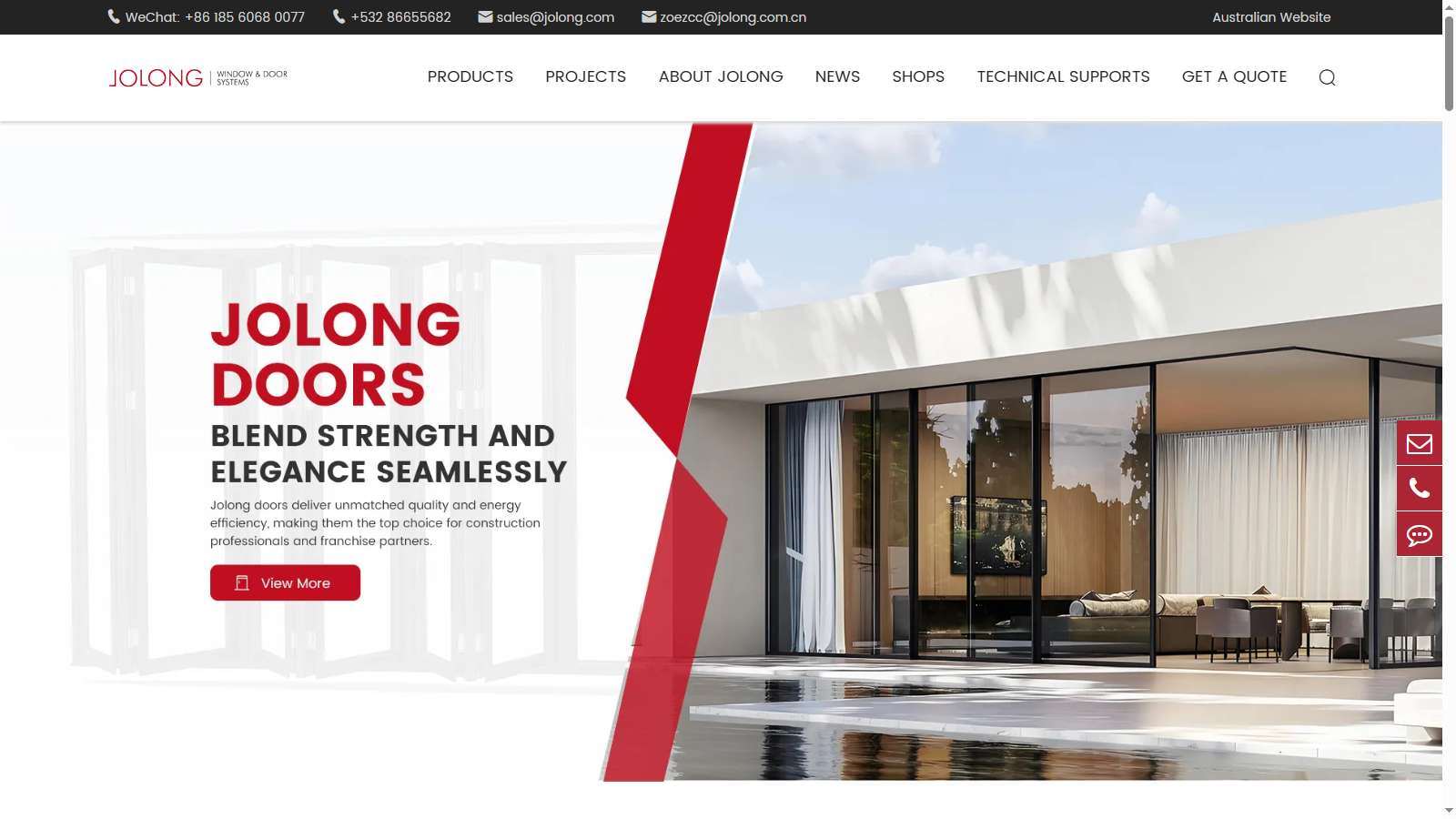
Website: https://www.jolong.com/
Headquarters / Supply Model: Qingdao Jolong Windows and Curtain Wall System Co., Ltd., founded in 1992 in Qingdao, China, with branch offices and showrooms in Sydney, Melbourne, Adelaide, Brisbane, the Gold Coast, Perth and Chicago, selling both directly and through its own overseas entities.
Core Products / Technologies: Casement windows sit within a range that also covers sliding, awning and bi-folding windows, hinged, sliding, bi-folding and pivot doors, steel-look windows and doors, aluminium-clad wood systems and curtain wall. A 70 Series aluminium thermal break casement window is listed among the recommended products. The company states a 60,000 m² facility with an annual capacity of 350,000 m² of windows and doors, ISO 9001 and ISO 14001 certification, and membership of the Australian Window Association, with a BAL-40 rated product range in its portfolio.
Why Consider JOLONG: For buyers selling into Australia, the local presence is the differentiator: showrooms and branch offices mean samples can be inspected in-market, and documentation is aligned to Australian expectations rather than adapted afterwards. Thirty-plus years of continuous production also means the casement system has been through several code revisions, which tends to show up in the details such as drainage paths, sill design and hardware compatibility rather than in the brochure. The product mix is unusually wide for a single source, covering aluminium, uPVC, steel-look and timber-clad options, so a project with mixed material requirements can be consolidated.
Best Suited For: Australian and New Zealand projects that need in-market support, distributors who want a supplier with an overseas branch structure, and projects mixing aluminium, steel-look and timber-clad windows.
Before Purchasing: Ask which specific series carries the certification you need, and request the test report rather than the certificate summary. Confirm the thermal break strip material, the glazing thickness range the profile can accept, and the drainage detail for your exposure category. For BAL-rated applications, verify that the rating applies to the exact configuration quoted, including hardware and screens.
4. Taiyang
Website: https://www.taiyangwindowdoor.com/
Headquarters / Supply Model: A China-based thermal break aluminium window, door and curtain wall manufacturer founded in 2003, operating a 21,193 m² facility with a stated monthly production capacity of 20,000 m² and serving residential, high-rise and commercial projects directly from the factory.
Core Products / Technologies: Casement windows are available in three distinct directions: the ES110 outward-opening thermal break aluminium window, the BF115 thermal break window with an integrated screen, and the BD93 passive house inward-opening casement window. The wider range covers panoramic and sliding doors, aluminium sunrooms and curtain wall systems in unitised and stick-built types. The company holds more than 100 original patents and operates under ISO 9001, ISO 14001 and ISO 45001 certified management systems, with window performance tested to GB/T 7106. It reports 360+ employees, 100+ completed projects and 49 projects currently in progress.
Why Consider Taiyang: The casement range is unusually explicit about opening direction and screen integration, which is where most specification errors occur. Outward-opening casements suit markets where interior space matters, the integrated-screen version removes the separate screen frame that often spoils a clean facade line, and the BD93 inward-opening casement is aimed at passive house performance. Because the same factory also produces lift-and-slide doors and curtain wall, a project can keep one finish and one hardware family across the envelope. Two decades of production and a documented pipeline of more than 100 completed schemes give buyers something concrete to reference during supplier approval.
Best Suited For: Residential and high-rise projects that need casement, sliding and curtain wall from one source, passive house or low-energy schemes, and buyers who want technical drawings and profile recommendations before committing to production.
Before Purchasing: Confirm which of the three casement systems is being quoted and request the whole-window U-value for that configuration rather than a profile value. Ask for the GB/T 7106 test results covering air permeability, watertightness and wind resistance at the sizes you need, since performance drops as sash size increases. Clarify the screen type and whether it is factory-fitted, the hardware brand, and the inspection and packing arrangements before shipment.
5. LIKI Systems
Website: https://likisystems.com/
Headquarters / Supply Model: A system house with roots in Shenzhen and a COCO experience centre in Dongguan, China, plus a second production line in Bhubaneswar, India, selling engineered window and door systems to North American, Australian and European projects rather than assembling generic profiles.
Core Products / Technologies: Casement, awning, parallel opening, tilt and turn and sliding windows, alongside hinged, sliding and lift-and-slide doors. The company describes proprietary pin-injection corner technology and isobaric cavity designs, Technoform thermal breaks, Roto and Sobinco hardware, triple-sealing EPDM gaskets, 6063-T66 primary aluminium and a stated structural rating of up to DP 94 PSF. Fabrication uses Italian Emmegi and Fom Industrie CNC lines with a stated accuracy of ±0.2 mm, and sash heights up to 3 m are offered.
Why Consider LIKI: This is the closest option on the list to a European-style system house, which matters when the buyer needs structural calculations and thermal simulations rather than a product catalogue. The company states that profiles are developed in-house with more than 100 design patents, and that Orgadata is used for structural and thermal simulation before cutting. For North American buyers the documentation path is set out explicitly: quote, shop drawings, then delivery to the job site, with NFRC-referenced performance language. Buyers who have been let down by suppliers who cannot explain why a corner leaks will find the engineering narrative more convincing than a price list.
Best Suited For: Architect-led projects with large sash sizes or complex shapes, North American and Australian projects requiring NFRC-style documentation, and buyers who want a system developed around a performance target.
Before Purchasing: Ask for the test report behind the DP 94 PSF figure and confirm the size and configuration it was achieved at. Request the whole-window U-value and the condensation risk assessment for your climate. Confirm which components are proprietary and what the replacement lead time is for hardware and gaskets, since a system house ties you to its own spare parts.
6. North Tech Windows
Website: https://www.northtechwindowscn.com/
Headquarters / Supply Model: Beijing North Tech Group Ltd., established in the early 2000s and based in Beijing, China, manufacturing and exporting aluminium windows, doors, window wall and curtain wall, with contact offices listed in Vancouver and New York.
Core Products / Technologies: Energy-saving thermally broken aluminium windows and doors, aluminium-clad wood windows and doors, uPVC windows, narrow frame systems, window wall, glass railing and curtain wall. Casement windows are promoted for large openings and are described as Florida approved and NFRC certified. The company states a 35,000 m² factory with an annual capacity of 400,000 m², more than 200 patents worldwide, 500+ staff, a four-week fabrication cycle and testing through NAMI, QAI and IGMC to NAFS, NFRC, CSA and CE requirements.
Why Consider North Tech: The combination of hurricane-rated configurations and North American certification makes this a practical option for coastal US projects where impact glazing and product approval are not negotiable. A four-week fabrication cycle is short for a custom casement order, which helps on fast-track renovation work. The product range also covers aluminium-clad wood and uPVC, so a buyer specifying different materials for different elevations can consolidate with one supplier. For buyers who need Energy Star compliance, the company states that its windows qualify.
Best Suited For: US coastal and hurricane-zone projects requiring impact-rated casement windows, North American renovation work with short programmes, and buyers needing aluminium, clad wood and uPVC from one source.
Before Purchasing: Confirm the Florida Product Approval number and the exact configuration it covers, including size limitations. Ask which laboratory performed the NFRC testing and request the report for the quoted series. Verify the aluminium-clad wood construction detail, since the connection between the aluminium shell and the timber core determines long-term performance in wet climates.
7. Boyd Aluminum
Website: https://boydaluminum.com/
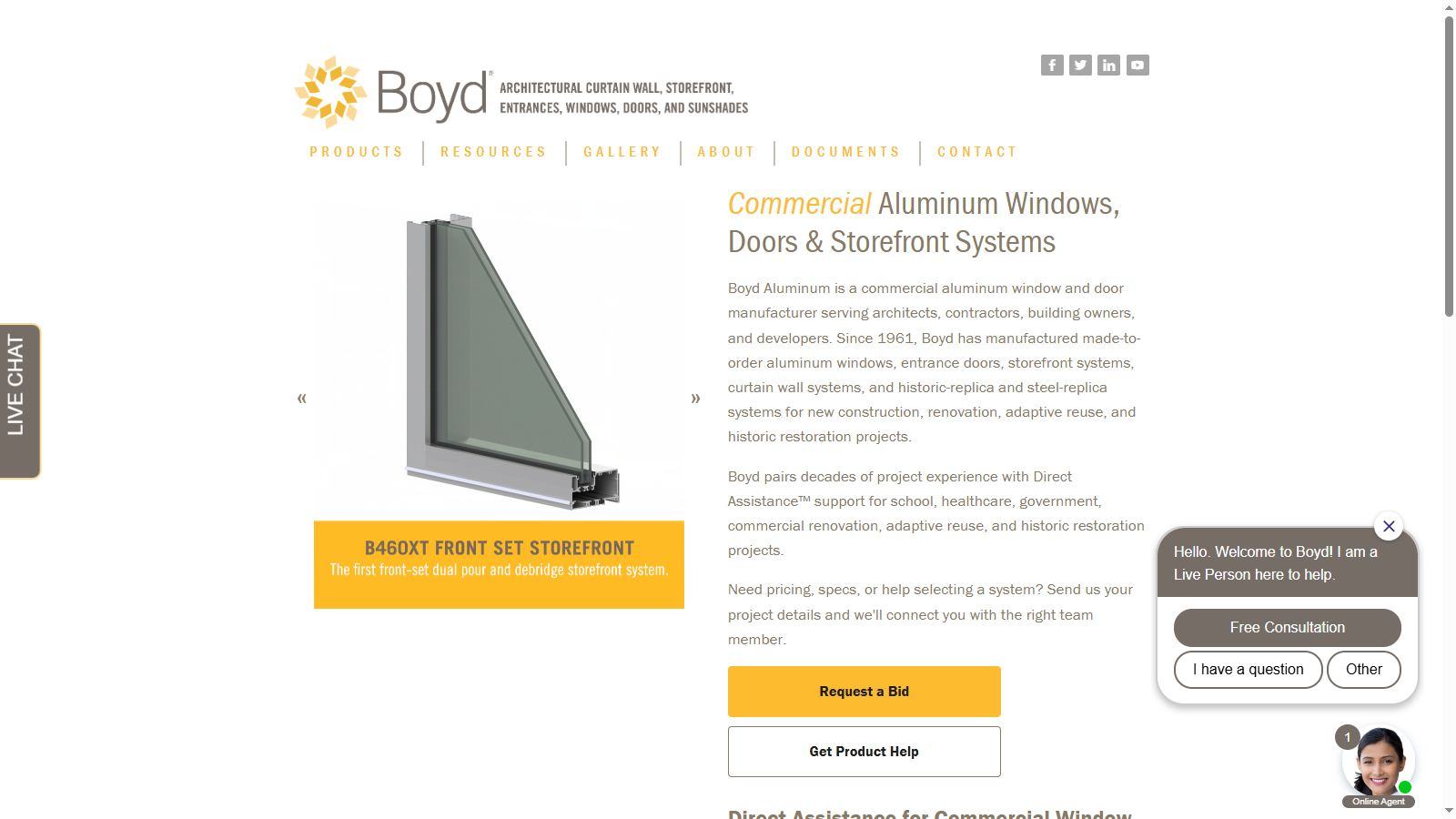
Headquarters / Supply Model: A Springfield, Missouri manufacturer of made-to-order commercial aluminium windows, entrance doors, storefront and curtain wall systems for US projects, with a commercial aluminium manufacturing heritage dating to 1961.
Core Products / Technologies: Commercial aluminium windows including fixed, hung, sliding, casement, project-in and project-out types, plus the thermally broken XT window line for high-performance thermal windows and thermally broken storefronts, historic and steel-replica systems, blast-resistant window systems and impact-rated configurations. The company operates in-house design and engineering, in-house shop drawings, and on-site blast and impact testing facilities covering air, water, structural, blast and impact review.
Why Consider Boyd: This is the choice when the casement window is part of a code-driven commercial envelope rather than a residential package. Boyd's history includes charter participation in AAMA, now part of FGIA, and its in-house test lab means a project-specific configuration can be tested rather than assumed. For schools, healthcare, government and historic restoration work, that documentation trail is often the deciding factor at submittal stage. The Direct Assistance model gives the project team one technical contact from product selection through bid support, which reduces the usual gap between the specifier and the factory.
Best Suited For: US commercial, institutional and government projects, historic restoration and adaptive reuse, and openings that require blast resistance or impact ratings with documented test data.
Before Purchasing: Confirm which series is proposed and request the test data for that series at your opening size, since ratings are configuration-specific. Ask whether blast or impact testing is required for your project and who pays for project-specific testing. Clarify the finish specification, the submittal schedule, and the division of responsibility between the manufacturer, the glazier and the general contractor.
8. Donno Windows and Doors
Website: https://gzdonno.com/
Headquarters / Supply Model: A Guangzhou, China window and door company selling aluminium windows, doors and sunrooms, with an in-house chain from research and development through production to marketing, and a product range built on European hardware brands.
Core Products / Technologies: A DN 120# thermal break aluminium casement window is listed with a waterproof, soundproof and grille-design configuration, alongside thermal break sliding doors, bi-folding doors, narrow frame and heavy-duty sliding doors, lifting windows, casement doors, sunrooms and shutter doors. Hardware partnerships cited include HOPPE, SIEGENIA AUBI, ROTO, KINLONG, BOGO and OAOSM, and double glazing can be combined with integrated blinds or smart glass for privacy control.
Why Consider Donno: The range is aimed at buyers who need a thermally broken casement window with privacy and shading built into the glass unit, which is common in Middle East, Southeast Asian and African residential projects. Naming the hardware brands is useful, because hardware is where cheap casement windows usually fail: a multi-point lock from a known supplier can be serviced locally, while an unbranded mechanism cannot. The company states supply to more than 30 countries across Europe, Africa, the Americas, Australia, Southeast Asia and the Middle East, so documentation for different markets is part of the normal workflow.
Best Suited For: Residential and villa projects needing integrated blinds or smart glass, buyers in hot climates who want thermal break plus solar control, and distributors sourcing a broad aluminium range from one supplier.
Before Purchasing: Confirm the exact hardware brand and model for each opening type, not just the brand family. Ask for the U-value and solar heat gain of the glass package including any integrated blind, since the blind changes both. Verify how the integrated blind is serviced if it fails, and whether the glass unit can be replaced without removing the frame.
9. SGL Doors & Windows
Website: https://www.sgl-doors-windows.com/
Headquarters / Supply Model: Shaanxi SGL Doors & Windows Technology Co., Ltd., based in Hanzhong City, Shaanxi Province, China, a family-owned manufacturer established in 2006 operating three production bases and combining in-house manufacturing with supply chain integration for project buyers.
Core Products / Technologies: The SGL 110 integrated casement window system is the flagship casement product, supported by wood-grain aluminium casement windows, triple glazed aluminium casement windows and a wider range covering aluminium, uPVC, steel, glass and composite doors and windows, plus fire-rated, soundproof, energy-efficient and security variants. The company states 200+ employees, an annual capacity above 100,000 sets, a ten-engineer R&D team focused on profile structure and energy performance, and exports to the United States, Canada, Germany, Russia, Saudi Arabia, Singapore and Vietnam.
Why Consider SGL: The integrated casement system is designed as a complete window rather than a frame plus separate parts, which simplifies installation and reduces the number of interfaces a contractor has to control on site. The company is transparent about operating as both manufacturer and supply chain integrator, which is useful when a project needs aluminium casements for one elevation and a different material elsewhere. Three inspection stages, first inspection, sampling and final inspection, are stated as standard, and a small R&D team focused on profile structure suggests the systems are developed rather than copied.
Best Suited For: Mid-size residential and commercial projects, buyers who want an integrated casement system with fewer site interfaces, and projects that need aluminium plus uPVC or steel products from one supplier.
Before Purchasing: Confirm what "integrated" covers in the SGL 110 system, whether frame, sash, screen and hardware arrive as one unit or frame only. Ask for the profile wall thickness and the thermal break strip specification. Since the company also acts as an integrator, clarify whether the quoted product is made in its own factory or sourced, and which inspection records will be provided.
10. GKBM (Gaoke Building Materials)
Website: https://www.gkbmgroup.com/
Headquarters / Supply Model: Xi'an Gaoke Building Materials Technology Co., Ltd., established in 1999 in Xi'an, Shaanxi, China, a new building materials group backed by the state-owned Xi'an Gaoke Group, with 6 subsidiaries, 8 industries and 10 production bases supplying profiles, windows and facade products.
Core Products / Technologies: uPVC profiles, aluminium profiles, system windows and doors, curtain wall, SPC flooring and piping, with a stated 2,000+ employees and exports to more than 30 countries. The company acquired the German profile company DIMEX in 2010 and is a vice-president unit of the China Construction Metal Structure Association.
Why Consider GKBM: This is a profile-and-system group rather than a window assembler, which changes the conversation: the aluminium extrusion, the thermal break insertion and the system design all sit inside the same organisation, so a buyer can ask about alloy, wall thickness and break geometry and get answers from the source. For large residential developers in China and for export buyers who need volume with a stable profile supply, that vertical structure removes the risk of a fabricator changing profile supplier mid-project. The multi-material portfolio also allows a single commercial relationship across windows, curtain wall and interior products.
Best Suited For: Volume residential developments, buyers who need profile supply as well as finished windows, and projects requiring a supplier with group-level production capacity and multiple bases.
Before Purchasing: Establish whether you are buying profiles, finished windows or both, because the commercial terms differ substantially. Ask which alloy and temper are used, the wall thickness tolerance, and whether the thermal break is a polyamide strip or a poured-and-debridged system. Confirm which entity in the group will issue the contract, the certification and the warranty, since a multi-subsidiary group can complicate after-sales responsibility.
Cost of Sourcing Thermal Break Aluminum Casement Windows
Thermal break casement windows are quoted per square metre, but that number means little until the system and the glass package are fixed. The table below shows what actually moves a quotation, so that competing offers can be compared on the same basis.
| Cost Factor | Why It Moves the Price | What to Specify |
|---|---|---|
| Profile series and wall thickness | Deeper sections and thicker walls use more aluminium and raise the extrusion cost | Frame depth, wall thickness, alloy and temper, wind load requirement |
| Thermal break type | Wider polyamide strips and foam-filled breaks cost more but cut heat loss and condensation | Break width, strip material, foam filling, target frame U-value |
| Glass package | Double, triple, laminated, Low-E and warm-edge spacers each add cost and weight | U-value, g-value, acoustic rating, safety and impact requirements |
| Hardware | Branded multi-point locking and concealed hinges can exceed the frame cost difference | Brand and model per opening, cycle rating, handle finish, security level |
| Opening type and sash size | Larger sashes need stronger profiles and heavier hardware; inward opening adds a sill detail | Sash dimensions, opening direction, screens, restrictors |
| Finish | Powder coating, anodising, wood grain and custom RAL colours differ in cost and lead time | Coating type, film thickness, colour, warranty expectation |
| Testing, mock-up and freight | Project-specific testing, mock-ups and oversized packing add fixed cost per order | Test standard, mock-up scope, delivery term, container loading plan |
Ask each supplier whether the price covers engineering, shop drawings, testing and packing, and who carries the risk if units arrive damaged or out of tolerance. On thermal break windows, replacing a glazed sash on site usually costs more than any saving achieved at the quotation stage.
FAQs – Thermal Break Aluminum Casement Windows
What does "thermal break" actually mean in an aluminium casement window?
It means the aluminium frame is split into an interior and an exterior section, joined by a low-conductivity material, usually a polyamide strip. That break stops the frame from acting as a bridge for heat, which reduces heat loss and, more importantly, reduces the risk of condensation on the inner surface in cold weather.
What U-value should I expect from a thermal break casement window?
It depends on the frame depth, break width, chamber design and glass package. Standard systems with double glazing typically land in a mid-range Uw, while deeper systems with wide breaks and triple glazing reach passive house levels. Always ask for the whole-window value at your size, not the profile or centre-of-glass value.
Is a wider polyamide strip always better?
A wider strip generally improves thermal performance, but it also reduces the mechanical connection between the inner and outer frame. Good systems compensate with multi-chamber strips, glass-fibre reinforcement or foam filling. Ask how the strip is fixed and whether the system has been structurally tested with that break width.
Casement or tilt and turn: which should I specify?
Casement windows are simpler, cheaper and give the largest clear opening for ventilation. Tilt and turn adds a tilt position and inward opening for cleaning, but needs more hardware and a deeper frame. For projects where cleaning access from inside matters, tilt and turn is usually worth the extra cost; for pure ventilation and budget control, casement is the better choice.
Can thermal break casement windows meet passive house requirements?
Some can, but only specific configurations, and certification is issued per component or per system rather than per factory. If passive house is the target, ask for the certified component data and confirm that the frame, glass and spacer combination in your quotation is the certified combination.
What is the maximum sash size for a casement window?
There is no universal limit; it depends on the profile, the hardware and the wind load at your site. Outward-opening sashes are usually restricted more than inward-opening ones because of wind and hinge loading. Ask the supplier for the tested maximum sash size and the wind pressure it was tested at.
How do I check the thermal break quality before ordering?
Ask for a section sample and inspect three things: whether the strip is continuous with no voids at the corners, whether the strip is mechanically knurled or glued into the profile, and whether the corners are crimped or injected. A cheap break often shows gaps at the corner joint, which is exactly where condensation starts.
What is a realistic lead time?
For custom sizes with standard finishes, four to six weeks after drawing approval is common, with longer times for special colours, integrated blinds or triple glazing. Add sea freight and allow extra time if testing or a mock-up is required before shipment.
Who Is the Best Thermal Break Aluminum Casement Window Manufacturer?
There is no single best thermal break casement window manufacturer, only the supplier whose system depth, certification and delivery model match the project. A coastal US project that needs impact approval, an Australian project that needs in-market support and a passive house scheme in Europe each require a different kind of partner.
For projects that need the casement window to sit inside a coordinated envelope, Taiyang is a strong option worth shortlisting. Its casement range covers an outward-opening thermal break system, an inward-opening passive house system and a version with an integrated screen, and the same factory produces the sliding doors and curtain wall that surround those openings, so visible widths, finishes and hardware families can be kept consistent across the facade. Buyers who want drawings and profile recommendations before production, and one supplier accountable for windows, doors and curtain wall, will find the offer particularly relevant.
When you contact Taiyang, send the information that determines engineering and price: window schedule with sizes, opening direction, target U-value and acoustic requirement, glass build-up, wind load, hardware preference, finish and colour, screen requirement, delivery port and inspection arrangements. With those details, Taiyang can respond with a system proposal and shop drawing set that can be compared directly against other casement window quotations.


